

News: Microelectronics
9 June 2026
Navitas introduces isolated through-hole package for 1200–3300V SiC MOSFETs
Gallium nitride (GaN) power IC and silicon carbide (SiC) technology firm Navitas Semiconductor Corp of Torrance, CA, USA has launched its new UHV-TO-247-4-ISO package, setting what is claimed to be a new benchmark for high-performance discrete power devices.
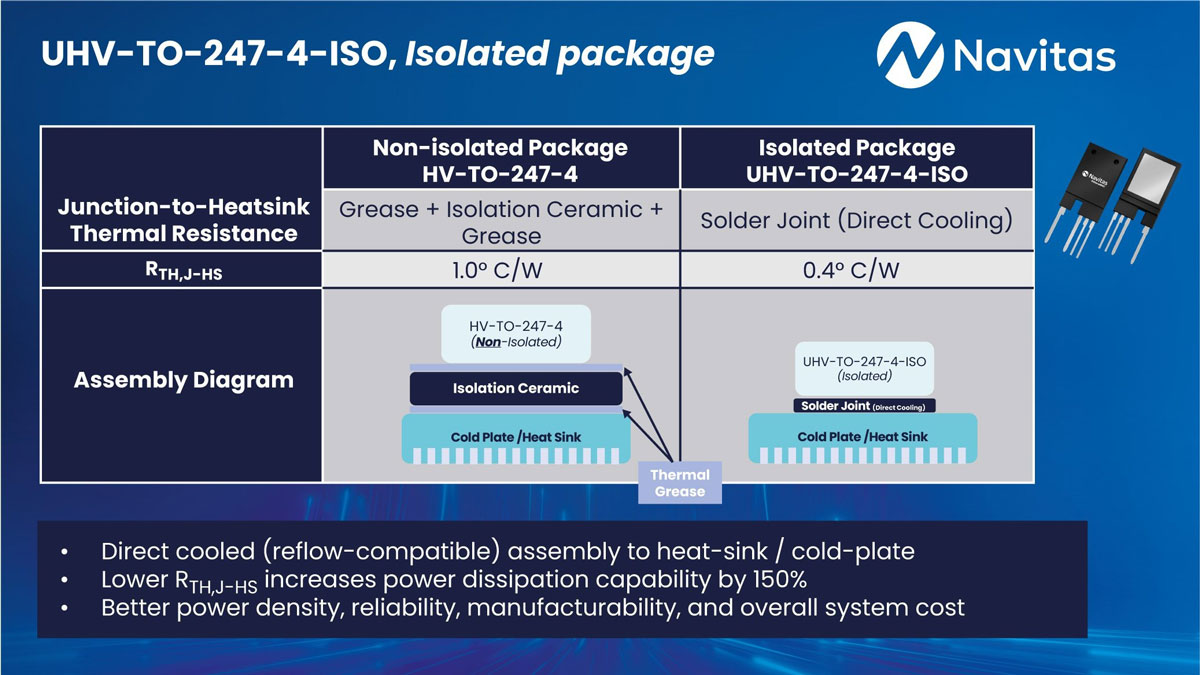
Featuring over 12mm pin-to-pin creepage and greater than 6000V integrated isolation, the package is purpose-built for 1200V to 3300V GeneSiC SiC MOSFETs, delivering module-like performance in a compact discrete form factor. Compared with standard non-isolated through-hole packages, this package not only eliminates the need for external high-voltage isolation but also improves thermal and EMI performance.
This expands Navitas’ packaging portfolio, including SiCPAK power modules, QDPAK, TO-247-LP, and other high-performance solutions, for more efficient, denser, scalable power systems in energy, grid, and AI data centers.
System benefits are cited as:
- Integrated high-voltage isolation: By integrating an aluminium nitride (AlN) substrate, this package offers robust high-voltage isolation exceeding 6000V — eliminating the need for external isolation materials and simplifying system design.
- Direct-cooled, reflow-compatible thermal management: A high-voltage isolated, reflow-compatible thermal pad lets the package mount directly to liquid- or air-cooled heatsinks, eliminating external thermal interface material (TIM). This reduces RTH,J-HS by up to 60%, leading to up to 150% increased power dissipation capability, improving power density, reliability, manufacturability, and overall system cost.
- Reduced coupling capacitance & radiated EMI: Integrated high-voltage isolation reduces die-to-heatsink stray capacitance compared to external ceramic-based isolators, effectively minimizing common-mode noise and radiated EMI. This enables higher switching speeds and delivers improved power density, increased system efficiency, and reduced system-level costs associated with EMI mitigation.
- Superior power and thermal cycling lifetime: Built on a high-performance AlN substrate with active metal brazing (AMB) technology and a robust reflow-compatible heatsink interface, this package eliminates the need for external TIM and isolation materials from the system stack — delivering superior power cycling capability and enhanced thermal cycling lifetime.
- Industry-standard form factor and footprint: Compatible with the established high-voltage TO-247-4 form factor and lead geometry, this package allows effortless system integration with no redesign — while delivering superior performance, increased reliability, and lower total system cost.
“High-power system design is fundamentally challenged by the need to balance efficient thermal management with robust high-voltage isolation,” says Paul Wheeler, VP & general manager of the SiC business unit at Navitas. “The UHV-TO-247-4-ISO package overcomes critical thermal and isolation challenges, delivering power module-class performance in a compact discrete form factor,” he adds. “As a highly efficient building block, it empowers system designers to unlock the full potential of GeneSiC TAP SiC MOSFET technology in next-generation applications such as immersion-cooled and liquid-cooled power electronics.”
Product portfolio:
The UHV-TO-247-4-ISO package is offered in 3300V, 2300V and 1200V SiC MOSFET ratings. This packaging development enables performance improvements in high-voltage grid-tied power conversion systems (PCS), solid-state transformers (SST), battery energy storage systems (BESS), and renewable energy applications.
The new package, together with its direct-cooled heatsink assembly, are available at Navitas’ booth #544 (Hall 9) at PCIM Europe 2026 (Expo & Conference on Power Electronics, Intelligent Motion, Renewable Energy and Energy Management) in Nuremberg, Germany (9–11 June).
Navitas unveils fifth-generation SiC Trench-Assisted Planar MOSFET technology
Navitas sampling 3300V and 2300V UHV silicon carbide product portfolio