

News: LEDs
3 September 2026
Towards full-color GaN micro-cavity LEDs
Researchers based in China, Saudi Arabia and Japan report progress in achieving broadly tunable, narrow-linewidth light emission from a single indium gallium nitride (InGaN) micro-cavity light-emitting diode (MCLED) with a 260nm spectral wavelength range, covering nearly 70% of the visible spectrum [Wei Ou et al, Optics Express, v34, p29827, 2026].
The team from Southern University of Science and Technology (SUSTech) and Xiamen University in China, King Abdullah University of Science and Technology (KAUST) in Saudi Arabia and Mie University in Japan hope that their work will constitute a step towards monolithic full-color light sources, as used in advanced displays. Although the work is promising, the team admits that the device is not yet suitable for practical application, suffering from thermal dissipation challenges, unbalanced RGB emission intensity, and poor uniformity.
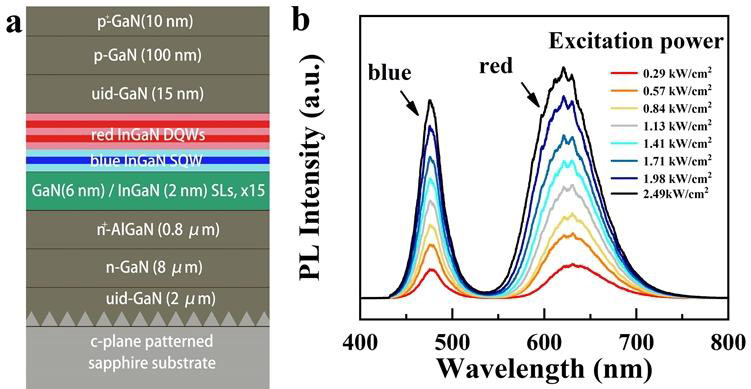
Figure 1: (a) Epitaxial structure, and (b) photoluminescence (PL) spectra of epitaxial wafer under variable power laser excitation.
The epitaxial material was grown by metal-organic chemical vapor deposition (MOCVD) on c-plane patterned sapphire (Figure 1). The nitride stack included blue- and red-emitting InGaN quantum wells (QWs). The red QWs were a doublet (DQWs), while the blue QW was a singlet (SQW). The red wells were deposited after the blue, since the higher-indium-concentration InGaN is less thermally stable under subsequent processing. The heavily doped n-type aluminium gallium nitride (n+-AlGaN) electron-injection layer was separated from the wells by a 15-period InGaN/GaN superlattice (SL) transition.
The researchers comment: “The patterned substrate, superlattices, and the blue SQW collectively function to release stress, which helps increase the indium composition in the quantum wells and improve crystal quality.”
Under PL, the material responded by emitting red (~632nm) and blue (476nm) light. The red spectral peak was broader and tended to shift more (14nm) in the blue direction under increased laser power. The blue-shift of the blue emission was only 1.2nm.
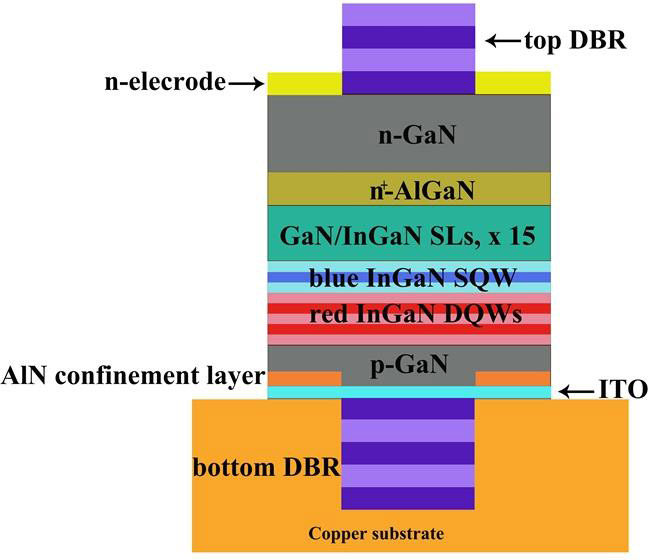
Figure 2: MCLED structure.
The material was fabricated into MCLEDs, using a flip-chip strategy (Figure 2). The structure is reminiscent of the recent report of an ultraviolet vertical-cavity surface-emitting laser (UV-VCSEL) by Xiamen and SUSTech.
High-thermal-conductivity AlN was used to create a 10μm aperture on the p-GaN. Indium tin oxide (ITO) in a 30nm layer encouraged current spreading across the low-conductivity p-GaN. The distributed Bragg reflectors (DBRs) consisted of alternating quarter-wavelength layers of silicon dioxide (SiO2) and titanium dioxide (TiO2).
The researchers report: “To realize efficient coupling between quantum wells and the anti-nodes of optical standing waves inside the resonant cavity for enhanced optical gain, a ~40nm-thick TiO2 interlayer is inserted between the bottom DBR and ITO film as an optical field modulation layer. Both DBR stacks achieve a reflectance of over 99% within their stopband.”
The bottom DBR was placed in a copper heatsink, applied by electrochemical deposition, creating a substrate.
The spectral emission profile of the device under current injection underwent a shift to shorter wavelengths, starting from red, through yellow and green to blue (Figure 3). This gives the device red, green, blue (RGB) emission capability.
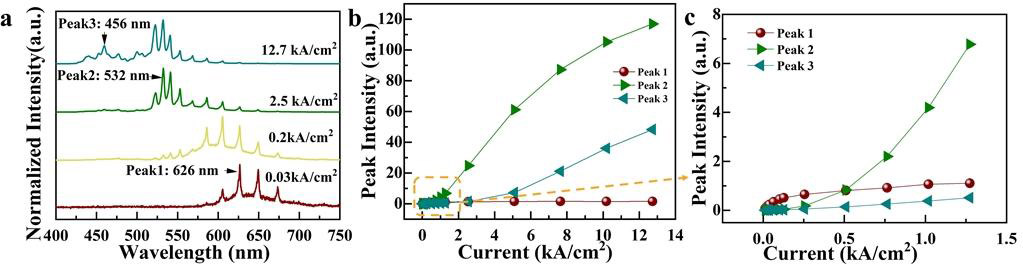
Figure 3: (a) Normalized electroluminescence (EL) spectra; (b) integrated intensities of peak1 (626nm), peak2 (532nm), and peak3 (456nm) versus injection current density. (c) Intensity variation up to 1.5kA/cm2.
The researchers comment: “Among these, the longest mode wavelength is approximately 673nm, which is the longest wavelength achieved to date in GaN-based resonant-cavity light-emitting diodes (RCLEDs).”
The diode uses enhanced spontaneous emission enabled by coupling with the optical cavity electromagnetic field (Purcell effect). There are also band-filling effects where carriers in the red DQW spill over into the blue SQW as the current injection increases. Another factor contributing to the device behavior is the screening of the quantum-confined Stark effect (QCSE) as the forward bias increases, flattening the energy bands.
The team reports: “The overall EL spectrum covers a range from 420nm to 680nm (approximately 260nm), with the green peak being the strongest. Visible light is generally considered to span 390nm to 770nm; thus, the EL spectral range of the device accounts for nearly 70% of the visible spectrum.”
In 2017, Xiamen reported an InGaN quantum dot micro-cavity LED with similarly tunable spectral capability, but with a much more limited range of around 129nm, from 564nm (yellow-green) to 435nm (violet). A further advantage over the QD device was a narrower linewidth less than 8nm full-width at half-maximum (FWHM), compared with a 20–60nm range in the QD case. Thus the latest LED offers much improved color purity.
The researchers see great potential for monolithic full-color display capability on a single chip: “The intensity discrepancies among the three primary colors at different injection current densities may be balanced by using time-multiplexing driving technology to balance the luminous intensities of RGB emissions. Specifically, within a single operation cycle, the light-emitting duty ratio of low-intensity red emission can be extended, while the duty ratios of brighter blue and green emissions are shortened, so that the three colors exhibit visually uniform brightness.”
The team has plans for detailed driving circuit design and packaging optimization.
The peak external quantum efficiency (EQE) reached 7.68% at low current density. After the peak, the EQE rapidly decreased to around 0.2%. The researchers comment: “We attribute this degradation primarily to the limited 10μm diameter of the device’s current injection aperture, which induces an abrupt surge in the current density within the quantum wells. Such high carrier densities and thermal effect substantially promote Auger recombination inside the quantum wells, which in turn suppresses the EQE.”
In other news, the maximum light output power was 264mW (336kW/cm2) at high injection. The turn-on voltage was 6.3V.
GaN micro-cavity LEDs GaN InGaN MOCVD
https://doi.org/10.1364/OE.606534
https://www.semiconductor-today.com/news_items/2026/
https://www.semiconductor-today.com/news_items/2017/
The author Mike Cooke is a freelance technology journalist who has worked in the semiconductor and advanced technology sectors since 1997.