

News: Markets
2 November 2026
Smartphone shipments fall 20% year-on-year in Q3, the lowest third-quarter total since 2013
Global smartphone shipments fell 20% year-on-year (YoY) to 254.7 million units in Q3/2026, according to Omdia, marking the lowest third-quarter shipment volume since 2013. Rising smartphone prices continued to weigh on consumer demand, particularly in emerging markets. Distributors and retailers also remained cautious about replenishing inventory ahead of the holiday season, as higher device costs increased working capital requirements and limited stocking volumes.
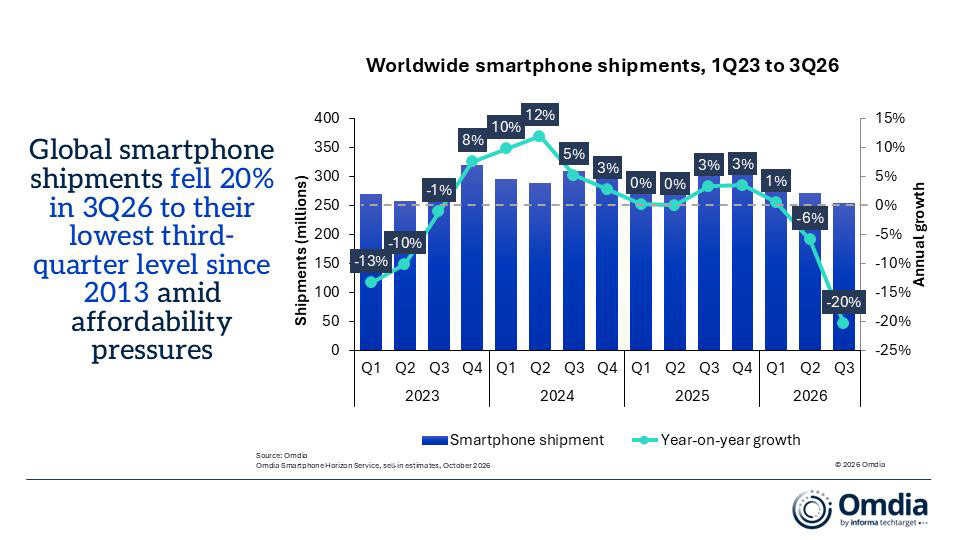
Picture: Worldwide smartphone shipments, Q1/2023 to Q3/2026.
Vendor highlights
Samsung retained its position as the world’s largest smartphone vendor, shipping 57.8 million units, down 5% YoY. Its entry- and mid-range Galaxy A series helped it to remain competitive as rival Android brands faced memory supply constraints and higher price. This supported Samsung’s shipment volumes and global market leadership. Meanwhile, the August launch of the Galaxy Z8 series, supported by trade-in and upgrade programs, strengthened its position in the premium segment.
Apple shipped 56.5 million iPhones in Q3/2026, remaining flat YoY despite the global market downturn. Resilient demand in China and North America offset weakness in key emerging markets, supported by sustained iPhone 17 demand and advance channel stocking ahead of anticipated price increases. In September, Apple introduced the iPhone 18 Pro, iPhone 18 Pro Max and its first foldable model, the iPhone Duo, while deferring the base iPhone 18 to 2027. This strategy extends the iPhone 17’s sales cycle while concentrating new-product demand on premium devices for the holiday season.
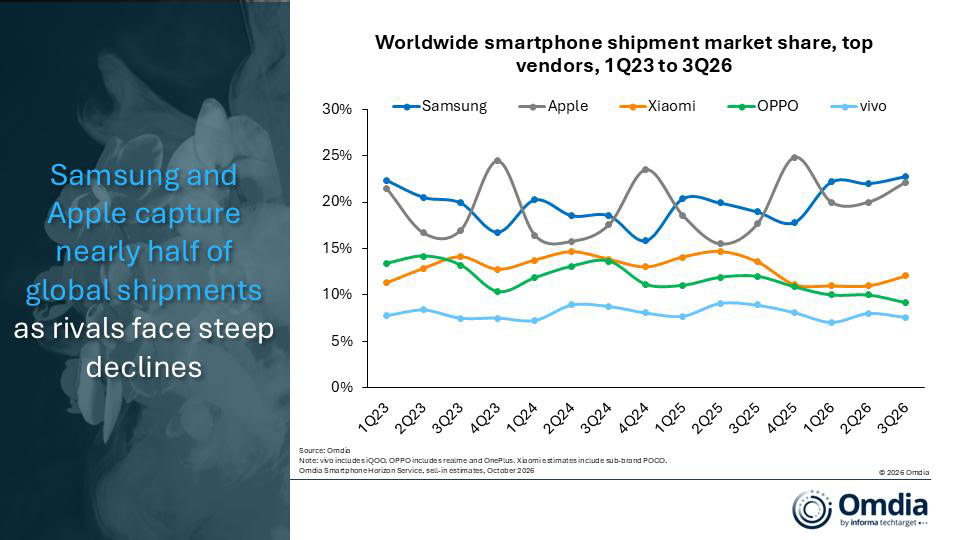
Picture: Worldwide smartphone shipment market share, top vendors, Q1/2023 to Q3/2026.
Xiaomi retained third place with 30.7 million units shipped, down 29% YoY, as shipments declined 20% in China and 28% in India. Amid rising component costs, Xiaomi continued to adjust prices across markets, prioritizing margin protection, with a more pronounced impact on volume in price-sensitive emerging markets. The Redmi A7 Pro and Redmi 17 helped to support shipments but were insufficient to offset the broader decline.
OPPO (including realme and OnePlus) ranked fourth with 23.4 million units shipped, down 39% YoY. vivo ranked fifth with 19.3 million units, down 33% YoY. Both vendors continued to raise prices across their core markets in response to rising component costs, making channel inventory planning more challenging.
Market dynamics: emerging markets face sharpest downturn as affordability pressures intensify
“Emerging markets, once the backbone of global smartphone volume growth, are now facing the greatest pressure from rising prices,” notes principal analyst Sanyam Chaurasia. “Africa recorded the steepest contraction at 39% YoY, as rising costs shifted vendors’ focus from aggressive expansion and market share gains toward margin protection and selective shipments, despite underlying demand. APAC (excluding Greater China), the Middle East and Latin America also declined by over 20%. Currency depreciation, inflation and rising living costs further weakened purchasing power, prompting consumers to delay upgrades or switch to refurbished smartphones and, in some lower-income markets, forcing them to opt for feature phones. In contrast, North America remained relatively resilient, supported by its premium-heavy market and established operator financing, trade-in and upgrade programs.”
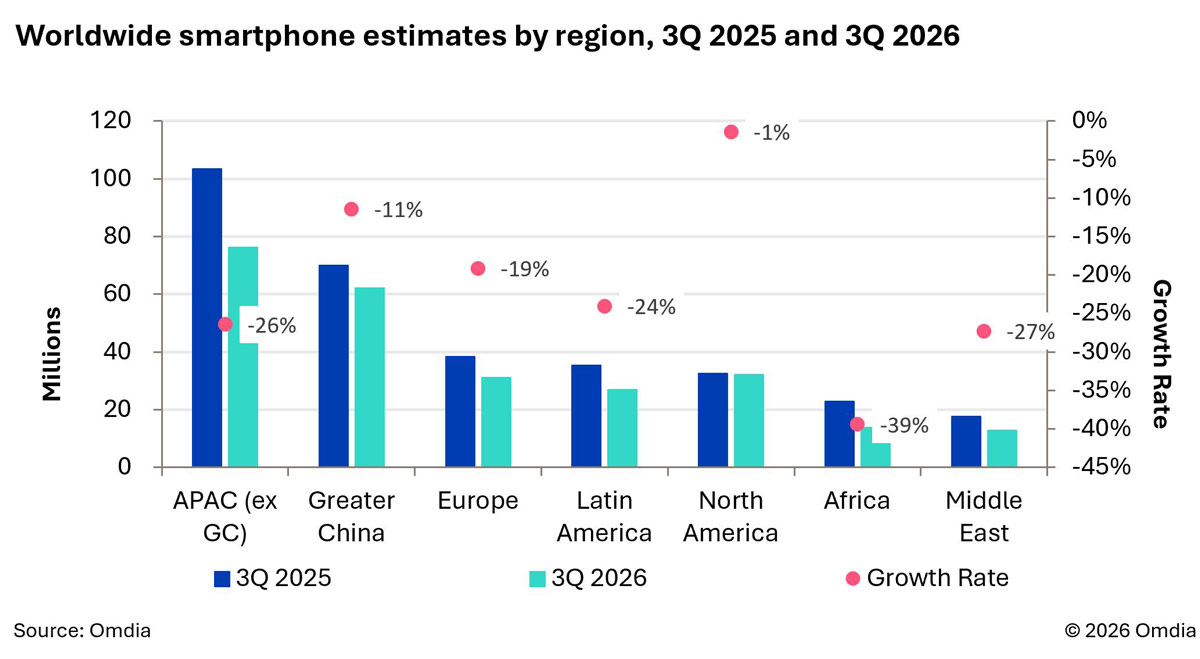
Picture: Worldwide smartphone estimates by region, Q3/2025 and Q3/2026.
Major mass-market smartphone vendors are increasingly prioritizing profitable markets and core product portfolios as component supply remains constrained. To remain competitive, they are adjusting RAM and storage configurations, reducing SKUs and selectively absorbing higher costs, while expanding higher-value portfolios to protect profitability.
Market outlook: rising costs and inventory pressures weigh on smartphone demand in 2026–27
“Omdia expects global smartphone shipments to decline by 12% in 2026, with further price increases and limited room for promotional discounts expected to weigh on demand during the holiday season,” says Amber Liu, practice leader at Omdia. “Beyond rising component costs, vendors face growing inventory risks as they balance existing stock with new product generations. Telecom operators and large-format retailers are better positioned to manage higher device prices and working capital requirements. Meanwhile, independent retailers face mounting pressure from slower inventory turnover and shrinking margins, potentially accelerating market exits.”
The global smartphone market is expected to decline further in 2027, albeit at a slower pace. Persistent high-bandwidth memory (HBM) shortages and constraints on conventional memory supply are expected to keep costs elevated, limiting relief for smartphone vendors. Vendors are expected to optimize sales, retail and marketing costs while pursuing additional revenue through software, services and post-sale offerings. Strong balance sheets, lean inventories and operational efficiency will become key competitive differentiators for vendors and channel partners.
Smartphone shipments shrink 20% in Q3/2026 as memory crisis reshapes competition
Smartphone market falls 4% year-on-year in Q2, driven by memory shortage
Smartphone shipments grow 1% year-on-year in Q1 to 298.5 million units
Smartphone shipments to fall 7% in 2026 amid memory constraints and geopolitical pressures