

News: Optoelectronics
16 April 2026
Vexlum and Menlo collaborate to streamline optical clock development
Finland-based laser developer and manufacturer Vexlum (which was spun off from Tampere University of Technology’s Optoelectronics Research Centre in 2017) and precision photonics technology provider Menlo Systems GmbH of Martinsried near Munich, Germany, are collaborating to accelerate the development of ultra-precise optical atomic clock timekeeping by providing an accessible, modular photonics source.
Currently, the complexity and cost make it difficult to build and operate optical atomic clocks at scale. Vexlum and Menlo are joining forces to develop a system that makes building optical clocks more accessible, reliable and cost-effective. The collaboration is part of the VEQTOR project, funded by EUROSTARS, a program supporting the advancement of quantum technology within Europe.
The aim of the collaboration is to combine Vexlum’s high-power lasers with Menlo’s precision metrology instrumentation, resulting in a standardized light source that fulfills the extreme requirements demanded by the most precise clocks to date, ultimately allowing research institutions and companies to easily build optical atomic clocks. Applications for optical atomic clocks include GPS-independent navigation, secure data synchronization on a continental scale, for example, for stock trading, and unlocking precise gravitational sensing for large-scale infrastructure monitoring and the test of fundamental physical theories.
Optical atomic clocks achieve accuracy levels that surpass microwave-based cesium atomic clocks by more than two orders of magnitude. This is because optical clocks ‘tick’ at the frequency of visible light, which oscillates about 100,000 times faster than microwaves, providing unparalleled resolution for time measurement. However, despite their extraordinary precision, optical clocks are not yet ready to deliver their full potential.
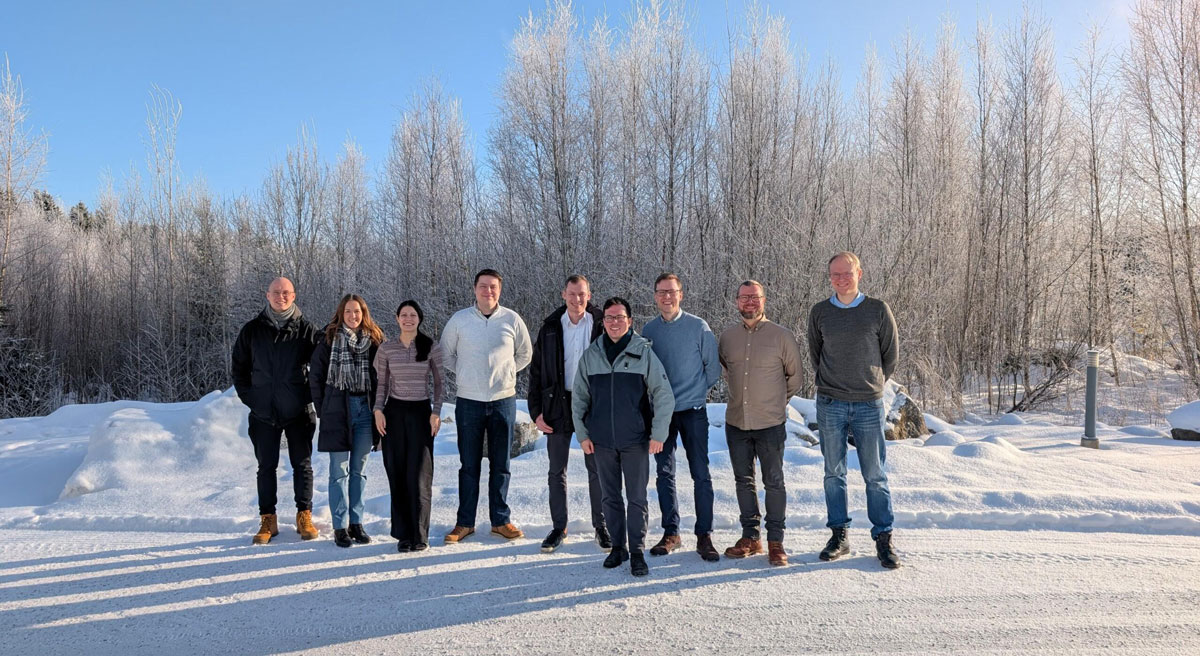
Picture: Group photo from VEQTOR kick-off meeting, Tampere, Finland: From left: Antti Rantaniemi, Riina Hietikko, Meri-Tuuli Pirttilä and Riku Keskinen of Vexlum, Martin Wolferstetter and Felix Balling of Menlo Systems, and Jussi-Pekka Penttinen, Tommi Hakulinen and Topi Uusitalo of Vexlum.
“The laser systems these clocks rely on are often sourced from several suppliers, are complex systems on their own, and typically require at least some level of hands-on operation,” says Dr Felix Balling, project lead at Menlo. “This, in turn, makes their system integration, stabilization, and 24/7 operation extremely difficult. Our collaboration with Vexlum aims to close this gap by developing a next-generation turn-key system that can make optical clocks practical, scalable, and ready for real-world use,” he adds.
By integrating a dedicated laser platform built by Vexlum, Menlo Systems addresses the challenge of sourcing the many different laser colors needed to cool, trap, initialize and measure the neutral strontium-87 (Sr) atoms used in the most advanced atomic clocks. Using its semiconductor laser technology, Vexlum says that it can easily provide all the laser solutions needed to work with Menlo Systems’ frequency control and metrology packages for any type of optical atomic clocks, enabling scientists to assemble their optical clock systems more rapidly.
“The rapid advances in laser and optics miniaturization are fundamentally changing the cost structure of quantum technology,” says Riina Hietikko, project manager at Vexlum. “By leveraging Vexlum’s vertical-external-cavity surface-emitting laser (VECSEL) technology, the necessary light sources can be provided in packages that are smaller, more robust, and more affordable than ever before. This level of integration means scientists can now skip the tedious, months-long effort of stabilizing and calibrating independent laser systems and jump straight to their experiments, accelerating discovery and the path to commercial applications.”
Both Vexlum and Menlo Systems are core partners in major EU-funded initiatives, including the Horizon Innovation Action project AQuRA (Advanced Quantum Clock for Real-World Applications).
These projects, which involve Finnish and German industrial and research institutions, are explicitly focused on strengthening the supply chain for robust, transportable optical clock components and accelerating the technology’s deployment from the laboratory into commercial and real-world environments.
Both Vexlum and Menlo are exhibiting their technology and talking about their new partnership in Noordwijk, Netherlands (20-23 April, at stands 13 and 11, respectively) at the 39th European Frequency and Time Forum (EFTF) international Conference and exhibition organized by the European Space Agency (ESA).
Vexlum raises €10m to scale VECSEL laser manufacturing
VEXLUM orders Riber MBE 412 cluster system