

News: LEDs
26 October 2026
UIUC achieves record modulation bandwidth of 2.75GHz for GaN blue micro-LEDs
University of Illinois at Urbana-Champaign (UIUC) has achieved a record modulation bandwidth of 2.75GHz in a gallium nitride (GaN) blue micro-LED (Abdelghany Abouelnagga et al, IEEE Electron Device Letters (21 October 2026); doi: 10.1109/LED.2026.3745737).
The work provides a systematic scaling roadmap for the micro-emitters, showing how they can replace conventional electrical copper links to break energy and bandwidth bottlenecks in data centers and next-generation AI computing.
As the demands of artificial intelligence and high-performance computing skyrocket, existing copper-based data interconnects are failing, as they consume massive amounts of power, produce significant heat, and can't sustain the needed data rates, notes the team. Optical interconnects offer a solution, but key challenges remain in creating compact, high-performance light sources. Micro-LED arrays are a promising candidate for creating massively parallel, error-free optical data links due to their compact footprint and potential for scalable integration.
Led by UIUC professor Can Bayram, the team tackled this challenge by designing and fabricating blue micro-LEDs across nearly two orders of magnitude, with diameters from 100μm down to a mere 2μm.
The team’s analysis identifies the crucial sweet-spots and limitations for future engineering, showing that aggressive scaling to the single-digit micron regime is the key. Their 5μm-diameter device achieved record bandwidth of 2.75GHz, while maintaining excellent linearity and stability under extreme current densities (of 15kA cm-2).
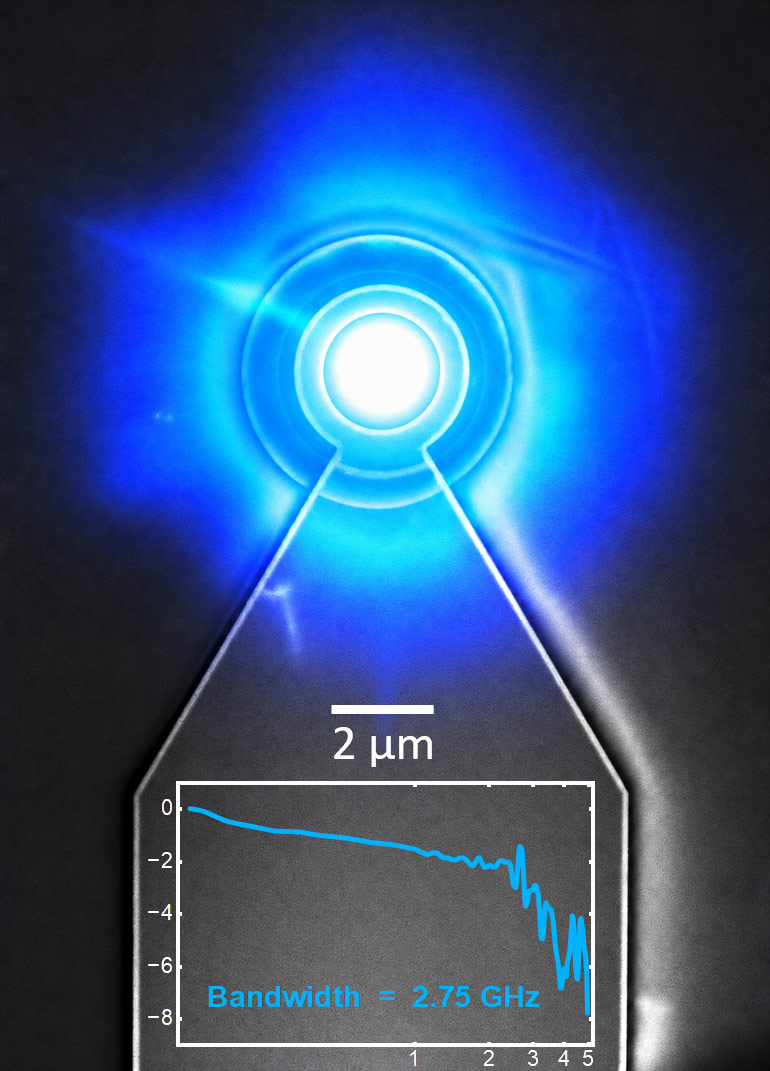
“By unifying modulation, linearity and impedance measurements across such a vast scaling range, we have for the first time established a device-level roadmap for micro-LED transmitters in high-bandwidth optical interconnects,” says Bayram. “Our work not only sets a record but also provides a clear pathway for designers to create dense, low-energy optical channels in a compact footprint, dramatically reducing the packaging complexity of future optical networks for AI.”
The technical analysis, including Smith-chart measurements of RF power delivery, explained exactly why the standard, large-sized (100μm) micro-LEDs were limited — primarily by junction capacitance. As they reduced the device diameter below 20μm, this capacitance dropped significantly, enabling the record speeds.
However, they also identified a new critical challenge: further miniaturization below 5µm increases contact and current-spreading resistances, creating an impedance mismatch with standard 50Ω radio-frequency systems. This critical insight defines the roadmap, identifying p-contact optimization and other pad engineering as the next steps to unlock even higher performance.
The team reckons that this work can break the data bottleneck by providing a roadmap towards dense, high-bandwidth optical links, ushering in the era of massively parallel optical communication for AI and high-performance computing.
Carried out in the Holonyak Micro and Nanotechnology Laboratory and Frederick Seitz Materials Research Laboratory at UIUC’s Central Research Facilities, the work was funded in part by the following programs: the US National Science Foundation Faculty Early Career Development (CAREER) Program under award number NSF-ECCS-16-52871; the Advanced Research Projects Agency-Energy (ARPA-E); the US Department of Energy, under the OPEN Program, award no. DE-AR0001558; the US Air Force Office of Scientific Research (AFOSR), under award no. FA9550-22-1-0326; and the Office of Naval Research (ONR), under award no. N00014-23-1-2423. The authors acknowledge material support from QROMIS Inc of Santa Clara, CA, USA.