
News: LEDs
29 October 2026
Seoul Viosys begins mass production of rare-earth-free white light emitter, with chips as small as 10µm
For three decades, white LEDs have depended on rare-earth materials such as yttrium aluminium garnet (YAG) layered onto a blue LED chip (Figure 1). Opto-semiconductor device maker Seoul Viosys Co Ltd (SVC) says that it has now broken that dependence by developing and mass producing a chip that emits white light without rare earths. The chip can be as small as 10µm.
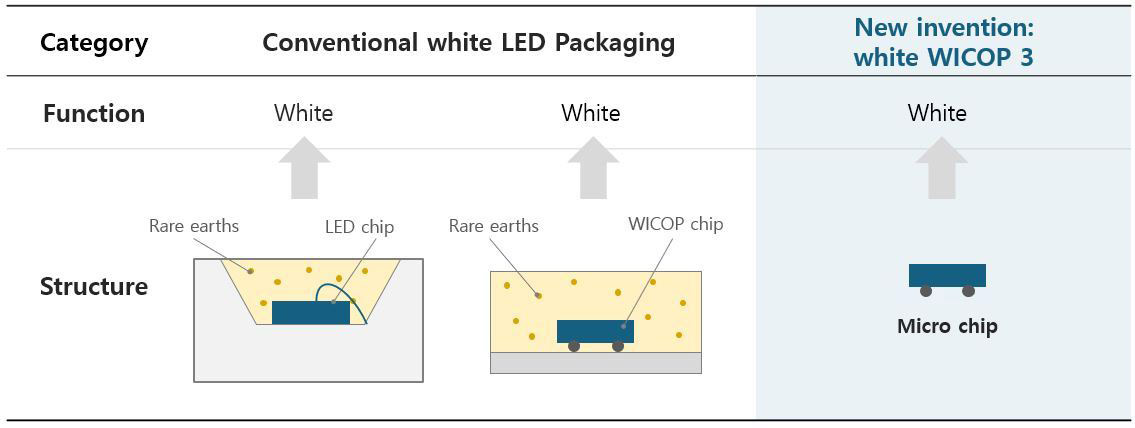
Figure 1. New invention: white WICOP 3.
Seoul Viosys and its parent company South Korean LED maker Seoul Semiconductor Co Ltd opened up the micro-LED market with WICOP (Wafer Integrated Chip on PCB), which is a chip architecture that eliminates the package altogether. With WICOP, the two companies have already developed and mass produced ultraviolet, blue, green, red and infrared LEDs smaller than 100µm in size. WICOP 3 is the third generation of the technology, extending that capability to white light without rare-earth elements (REEs).
White LED market
White LEDs comprise about $10bn of the $15bn global market for packaged LEDs. WICOP 3 can now replace them with a technology free of rare earths, reckons the firm.
More significantly, WICOP 3 is claimed to be the world’s first white opto-semiconductor to achieve white light in a micro-LED smaller than 100µm.
WICOP 3 uses neither rare earths (a major source of environmental pollution) nor a package. Nor does it contain synthetic silicone resins, plastics or lead frames used in conventional LEDs. The result is said to be a far more environmentally friendly product that costs about half as much to make as a conventional white LED.
Creating new markets
The miniaturized transistor replaced the vacuum tube and created vast new markets in electronics. The company believes micro white opto-semiconductors can do the same.
WICOP 3 generates white light from gallium nitride (GaN) alone. Also, the chip contains no plastics, silicone or other synthetic organic materials. It can hence last for decades. In lighting, invisible micro-emitters could be embedded in wallpaper or window glass, lighting a space with no fixtures at all. This would end the inconvenience of replacing bulbs and the high cost of fixtures. The company expects this to create a new market tens of times larger than today's $10bn white LED market.
Performance
In its first mass production, a micro-LED chip measuring just 25µm x 10µm produced 0.015lm of white light. Its chromaticity falls inside the CIE standard white region (Figure 2). Luminous efficacy is already close to 100lm/W. The company aims to reach 200lm/W within two years. A conventional 1000µm x 1000µm chip achieves 50lm.
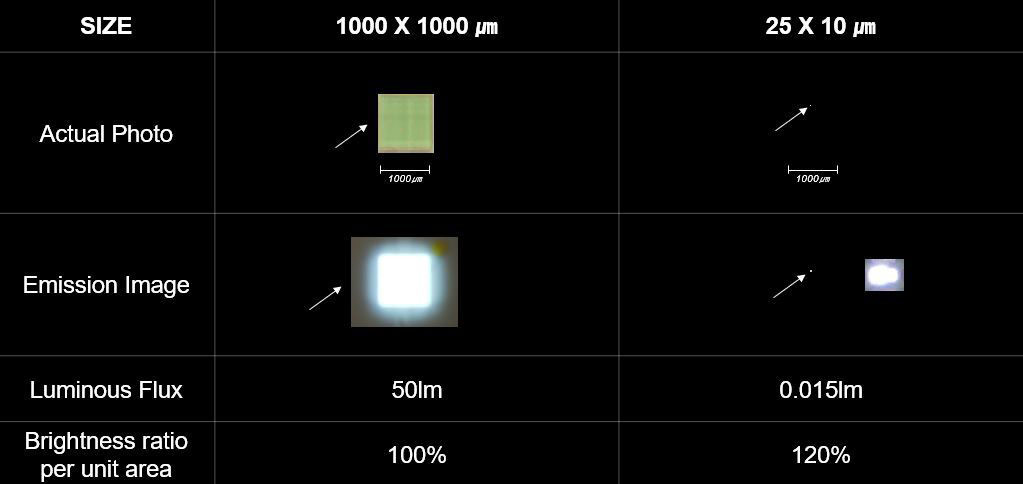
Figure 2. WICOP 3 brightness by size.
Technical significance
Up to now, WICOP could make chips smaller, but white light still required a package containing rare earths. White chips therefore could not go below 1000µm. This held back cost reduction. White micro LEDs under 100µm (0.1mm) were also out of reach. Removing rare earths changes that. White light is now possible both in large chips of 1000µm and above and in micro LEDs below 100µm.
Future plans
Seoul Group (consisting of Seoul Semiconductor and Seoul Viosys) will start mass production of WICOP 3 in fourth-quarter 2026. It says it will supply first those customers that have respected its intellectual property and relied on its products.
Seeking supply chain partners
Seoul Viosys uses WICOP to produce micro-emitters smaller than 100µm. Micro-LEDs built on WICOP can now carry high volumes of AI data over distances from under 1cm to tens of meters. Over short distances, data has long traveled electrically through copper wire.
Under the data loads of the AI era, copper links slow down, generate heat and consume much more power. Using light instead, Seoul Viosys arranges 1000 WICOP chips of about 10µm each in a grid within an area of 1mm2 or less. This array transmits data 10 times faster at one tenth of the power. Market research firms including Omdia forecast that this technology and augmented reality (AR) together will create a new $60bn market within five years (equal to half of today's DRAM memory market).
Seoul Semiconductor’s founder Chung Hoon Lee says that the company intends to target WICOP 1, 2 and 3 at applications in AR glasses and AI data communications. These technologies work on scales of 10µm or less. To that end, it is seeking trusted upstream and downstream micro-LED supply chain partners in AR displays and AI transmitters.
Seoul Viosys expanding business beyond components to data-interconnect transceivers