
News: Microelectronics
3 November 2026
Bosch to form dedicated semiconductor division, targeting growth in new markets
Aiming to generate €5bn in semiconductor sales by 2030, as part of reorganizing its corporate structure and the evolution of Bosch Mobility (announced at the end of October), on 1 January 2028 Germany-based tier-1 automotive supplier Bosch will transfer its semiconductor operations (currently part of its Mobility Electronics division) to a new division called Semiconductors, while continuing to be assigned to the Mobility business sector.
“Semiconductors are the linchpin of our connected world and, at the same time, a key success factor for all of Bosch’s divisions,” says Markus Heyn, deputy chairman of the board of management of Robert Bosch GmbH and chairman of the Mobility business sector.
The company aims to tap into additional sales and growth opportunities for its semiconductors not just in its existing automotive and consumer businesses — such as smartphones and wearables — but also in pioneering applications in robotics, where Bosch chips are already being used.
“Bosch semiconductors already enable efficient control of humanoid robots. In the future, high-precision, innovative sensors will serve as the foundation for additional smart systems,” Heyn says. Bosch already supplies components for the global robotics industry, as well as sensor technology across the entire robotics spectrum — from robotic vacuum cleaners to humanoid robots. Moreover, it will increasingly open up its manufacturing capacity to external partners in the future and systematically expand its foundry business.
Bosch investing in global semiconductor business
“By establishing our own unit, we’re opening a new chapter in our more than 60-year history in the semiconductor industry,” says Erik Rein, who is responsible for Bosch’s semiconductor business. “In the future, we’ll be able to better tailor our services to our customers’ needs — in the automotive sector, consumer electronics, and beyond,” he adds. “Our unique strengths in the semiconductor business are our market and technology leadership in MEMS sensors, as well as the way we’ve integrated semiconductors into our systems business. In particular, that includes silicon carbide (SiC) chips and application-specific integrated circuits (ASICs). We want to build on these strengths and leverage them in select new markets.”
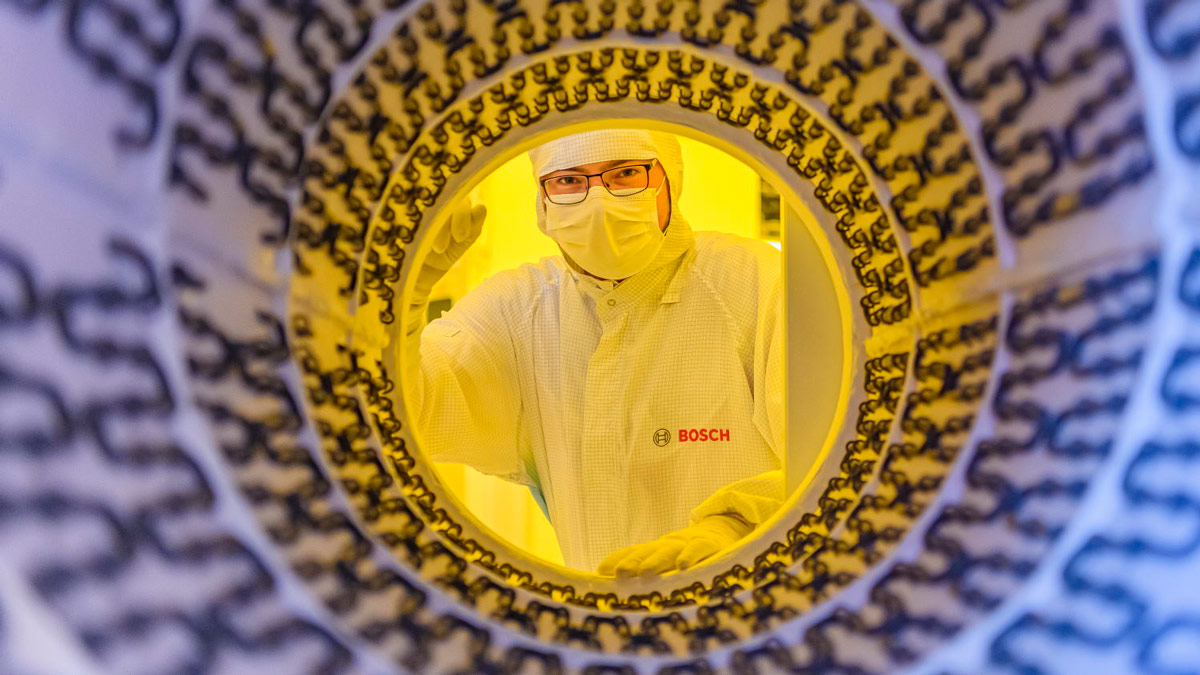
Picture: An application engineer checks heating cassettes for high-temperature furnaces at Bosch’s semiconductor plant in Dresden, Germany.
Bosch has about 40 semiconductor sites worldwide dedicated to research, development and manufacturing. In recent years, the company has invested about €3bn in its wafer fabs in Dresden and Reutlingen, Germany. In Roseville, California, Bosch is spending about US$2bn to equip its plant with facilities to manufacture SiC chips. To strengthen its global resilience, the firm also plans to further expand its test center in Penang, Malaysia, by the middle of the next decade. Also, Bosch holds a 10% stake in the European Semiconductor Manufacturing Company (ESMC) GmbH joint venture in Dresden.
Control units and power electronics for in-house automotive business
To date, the semiconductor business has been part of Bosch’s Mobility Electronics division, as has Bosch’s in-house business with electronic control units and power electronics. With effect from January 2028, the Mobility Electronics division will encompass the business related to electronic control units for automotive applications.
Bosch gains $225m US CHIPS funding for $2bn transformation of Roseville fab for SiC production
Bosch sampling third-generation SiC chips to global automakers
Bosch acquiring US chipmaker TSI, adding California plant to Reutlingen and Dresden fabs in Germany