

News: Markets
9 March 2026
Smartphone production grows 2.5% to 1.25 billion units in 2025
Global smartphone production grew 2.7% quarter-on-quarter from 328 million units in third-quarter 2025 to 337 million units in fourth-quarter 2025, supported by strong shipments of Apple’s new iPhone lineup, according to market research firm TrendForce.
For the full year, both Apple and Samsung each produced nearly 240 million units, tying for the top position in global smartphone production.
The smartphone market in first-half 2025 benefited from China’s subsidy programs, while second-half 2025 was supported by the traditional seasonal peak, bringing total production to about 1.254 billion units, up 2.5% year-on-year.
Looking ahead to 2026, surging memory prices are expected to increase smartphone production costs significantly. As a result, global smartphone output is projected to decline by at least 10% year-on-year to around 1.135 billion units. Smartphone brands will face a difficult choice between raising prices to preserve margins or lowering specifications to sustain shipment volumes, with the entry-level segment expected to bear the brunt of the impact.
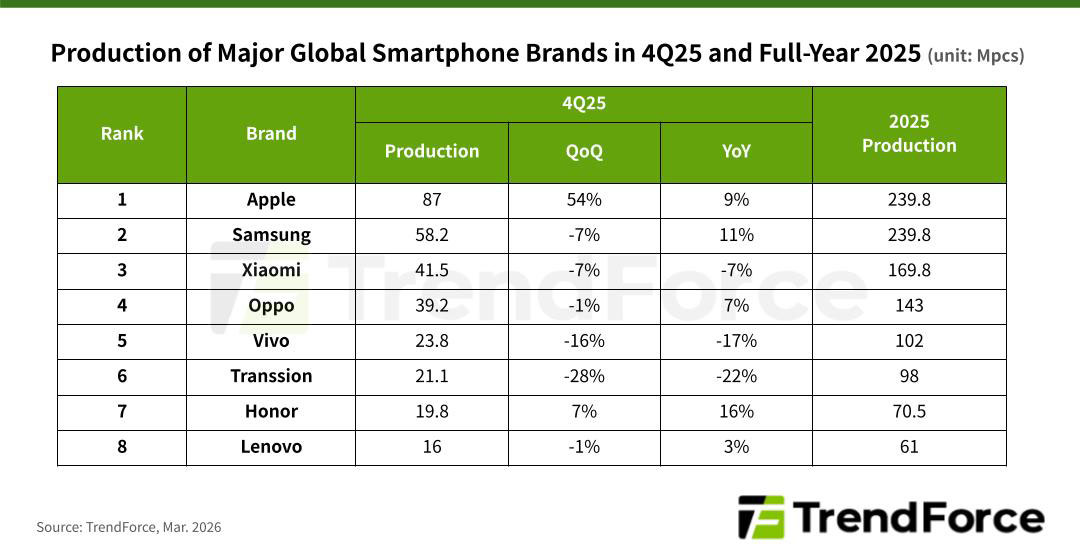
In 2025, the iPhone 17 series benefited from well-positioned retail pricing to deliver strong market performance. Apple’s smartphone production in Q4/2025 hovered around 8.7 million units, representing more than 50% quarter-on-quarter growth and marking a new quarterly record. If Apple adopts a more aggressive pricing strategy in 2026, it could help to sustain both production and sales momentum.
Samsung produced about 58.2 million smartphones in Q4/2025, an 11.1% year-on-year increase. With a higher proportion of premium models and strong vertical integration across the supply chain, Samsung may maintain or potentially expand its market share in 2026 by delaying price hikes and limiting the magnitude of retail price increases, reckons TrendForce.
Xiaomi (including Redmi and POCO) ranked third globally in 2025 with annual production close to 170 million units. In Q4/2025, Xiaomi reduced output by about 7% quarter-on-quarter, partly to adjust inventory from the previous quarter and partly due to its high exposure to entry-level devices. This prompted early production adjustments in response to rising memory prices. In 2026, Xiaomi is expected to increase the proportion of mid- to high-end models to stabilize profitability.
Oppo (including OnePlus and Realme) ranked fourth with 143 million units produced in 2025. Because Realme focuses on low-cost, high-performance devices that are particularly sensitive to component price increases, the group began reducing the share of Realme’s entry-level models toward the end of 2025 to stabilize overall operations.
Vivo (including iQOO) ranked fifth. The company adopted a cautious production strategy in Q4/2025, reducing output by roughly 16% quarter-on-quarter, primarily due to soaring memory prices and intensified competition from Huawei’s Nova series.
Transsion (including TECNO, Infinix, and itel) ranked sixth, sharply cutting smartphone production in Q4/2025 to 21.1 million units, a 28% quarter-on-quarter decline. Given the brand’s strong focus on entry-level models, this reduction in production could help to relieve inventory pressure while preparing for a potential demand slowdown in emerging markets.
Honor, which ranked seventh, accelerated production toward the end of 2025, driving 7% quarter-on-quarter growth in Q4/2025. However, the company, along with Xiaomi, Oppo and Vivo, will face dual pressure in 2026 from intensifying competition with Huawei and rising memory costs.
Lenovo (including Motorola) ranked eighth globally, producing about 61 million smartphones in 2025. Production in Q4/2025 remained largely flat compared with the previous quarter. In 2026, Lenovo’s production adjustment is expected to be relatively limited, supported by its operator-driven sales channels and the company’s large PC business, which helps to secure a more stable memory supply.
Smartphone production grows 9% in Q3/2025, driven by seasonal demand and new product releases
Smartphone production grows 9.2% in Q4/2024 to 334.5 million units