

News: Markets
4 June 2026
AI data-center expansion to drive monthly capacity of EML and CW-DFB lasers to 50.7 million in 2026
As the rapid expansion of AI data centers and the intensifying race for AI computing power are accelerating the transition toward transmission speeds above 1.6Tbps, major players such as NVIDIA, Google and Meta are securing a stable supply by strategically locking in production capacity from suppliers of electro-absorption modulated lasers (EMLs) and continuous-wave distribute feedback laser diodes (CW-DFB LDs), notes market research firm TrendForce.
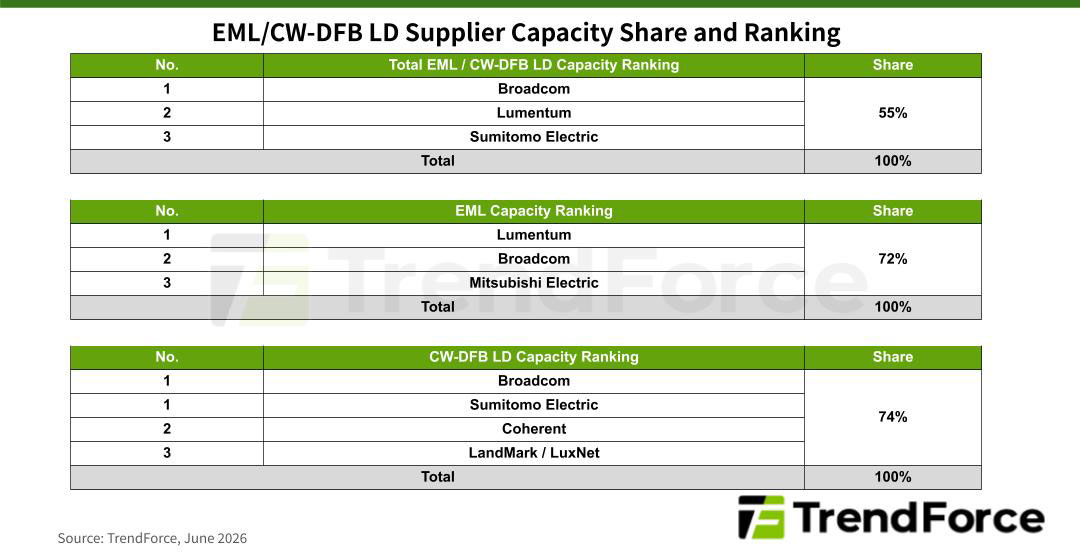
This has prompted suppliers to aggressively expand capacity in response to customer demand, doubling the combined monthly production capacity for EML and CW-DFB LDs to around 50.7 million units in 2026. The top three suppliers, Broadcom, Lumentum, and Sumitomo Electric, are expected to collectively account for 55% of the market.
EMLs are high-performance optical communication components that integrate a laser source and an electro-absorption modulation (EAM) onto a single chip. Since the laser diodes remain continuously active, EMLs offer ultra-low noise interference and extremely narrow spectral characteristics.
This makes them ideal for data transmission exceeding 800Gbps and for medium-to-long-distance transmission exceeding 2km. Given the high technical barriers, the top three suppliers — Lumentum, Broadcom, and Mitsubishi Electric — collectively hold about 72% market share.
Lumentum is not only aggressively expanding production capacity for 100/200Gbps EML products but also demonstrated 400Gbps-per-lane EML technology in March at the Optical Fiber Communications conference & exhibition (OFC 2026) in Los Angeles to address future 3.2Tbps market demand.
Additionally, while NVIDIA-led EML solutions focus on maximizing signal integrity and transmission performance, other cloud service providers (CSPs) are actively developing CW-DFB LDs for optical circuit switches (OCS) and silicon photonics co-packaged optics (SiPh CPO) solutions.
Broadcom and Sumitomo Electric currently lead the industry in CW-DFB LD production capacity, followed by Coherent and LandMark/LuxNet. Together, these suppliers account for about 74% of total market capacity.
Meanwhile, Coherent is accelerating the transition toward 6-inch indium phosphide (InP) epiwafer production to support large-scale manufacturing while also developing 400mW CW-DFB LDs for silicon photonics pluggable transceivers and co-packaged optics applications.