

News: Microelectronics
8 June 2026
Fraunhofer IAF presents innovations at PCIM
At the PCIM Europe 2026 (Power Electronics, Intelligent Motion, Renewable Energy and Energy Management) Expo & Conference in Nuremberg, Germany (9–11 June), Fraunhofer Institute for Applied Solid State Physics IAF is presenting the latest developments in gallium nitride (GaN) power electronics.
The highlight is a demonstrator of a bidirectional, single-phase 800V DC off-board charging systems for electric vehicles. It was developed by partner Ambibox GmbH as part of the project ‘GaN4EmoBiL’ (‘GaN Power Semiconductors for Electric Mobility and System Integration via Bidirectional Charging’) — which was launched in mid-2023 and funded by the Federal Ministry for Economic Affairs and Energy (BMWE) as part of the ‘Elektro-Mobil’ program — and incorporates a 1200V GaN-based power electronics module developed by Fraunhofer IAF for 800V bidirectional direct current (DC) charging systems.
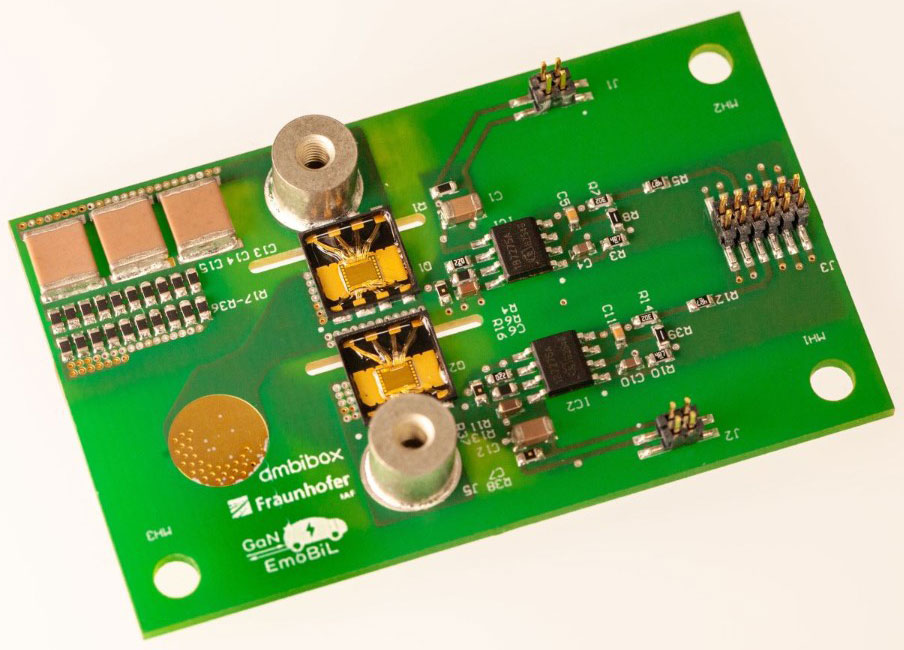
Picture: Close-up of the power module developed and manufactured at Fraunhofer IAF, featuring 1200V-class GaN transistors on an insulating substrate for use in bidirectional DC charging systems. © Fraunhofer IAF.
The module uses 1200V GaN devices fabricated on an insulating substrate. The properties of the devices are to be evaluated through their use in the demonstrator with battery voltages ranging from 150V to a maximum of 920V. The development underscores the enormous potential that GaN-based power electronics hold for the future of electric mobility, says Fraunhofer IAF.
Bidirectional, single-phase 800V DC charger for 3kW power
“The single-phase demonstrator of an off-board EV charger with up to 3kW of bidirectional power addresses an existing gap in the trade-off between cost, flexibility, efficiency and compactness for bidirectional charging,” says junior professor Dr Stefan Mönch, coordinator of the GaN4EmoBiL project. Currently, electric vehicles are equipped with permanently installed on-board chargers to convert the alternating current (AC) from a household outlet or public charging station into the direct current (DC) required by the electric car, for example, at a power level of 11kW or 22kW for fast charging.
However, on-board chargers incur high costs due to their size, weight and technical complexity. The off-board charger developed in GaN4EmoBiL represents a significantly more affordable and flexible alternative: Although its 3kW power output results in a slower charging speed compared to on-board charging systems, it is mobile, much more compact, lighter and versatile thanks to its CCS (Combined Charging System) plug and Schuko plug. The demonstrator has a total volume of 8.3 liters and a total weight (including plugs) of 5.7kg.
Another advantage is its bidirectional charging capability. “Bidirectional charging at high reverse voltages, as enabled by the demonstrated GaN charging system, is a key pillar in making the energy system more flexible,” says Achim Lösch, business developer for High-Frequency and Power Electronics at Fraunhofer IAF. Through bidirectional charging, an electric car can function not only as a means of transportation but also as an energy storage device. During periods of oversupply, it draws power from the grid; during peak loads, it feeds power back into the grid.
GaN power electronics for energy technology: Fraunhofer IAF at PCIM 2026
“At Fraunhofer IAF, we are developing innovative GaN devices and integrated power circuits (GaN power ICs) that are not only efficient but also significantly advance miniaturization at the system level through functional integration,” says Dr Michael Basler, researcher in GaN power electronics at Fraunhofer IAF. “At the same time, we are advancing the scalability of these technologies in terms of voltage class, current-carrying capacity, and wafer size. Our goal: wide-bandgap performance at silicon prices.”
At PCIM 2026, Fraunhofer IAF is providing an overview of its R&D on GaN power electronics, focusing on the topic ‘Power Electronics for Energy Technology’ in 2026. In booth 260 (Hall 6) at the exhibition, Fraunhofer IAF is showcasing various GaN-based power electronic components and modules, with the highlight being the bidirectional EV charging system demonstrator. During the conference, four researchers from Fraunhofer IAF are presenting their current work in lectures and poster sessions.
PCIM conference presentations by Fraunhofer IAF
- 9 June (9:45am, Stage: Tokio, Level 3): Opening keynote: ‘The GaN Evolution: Lateral, Vertical, and Bidirectional – What’s Next?’ by Dr Michael Basler, providing an overview of the development of GaN transistors for power electronics to date, explaining their advantages, and looking ahead to upcoming innovations;
- 9 June (11:40am, Stage: Tokio, Level 3): ‘GaN-HEMTs vs. GaN-‘Bricks’: A Device Concept Comparison’ by Richard Reiner;
- 10 June (10:25am, Technology Stage): ‘Scaling Up the Power of GaN Technologies: Paving the Way for the 1200V Class and Beyond’ by Richard Reiner;
- 10 June (12:45–2:15pm, Hall 4A), Poster Session ‘Advanced Power Devices’: ‘A 600V Three-Phase Inverter as GaN Power Converter IC on Substrate Biasing-Free Isolating Substrate’ by Dr Stefan Mönch;
- 10 June (3:30–5pm, Hall 4A), Poster Session ‘GaN Devices and Driving’: ‘The Influence of Field Plates on the Dynamic RON in GaN-Based Monolithic Bidirectional Switches’ by Daniel Fugmann;
- 11 June (11:45am): Panel discussion ‘What’s up, What’s Next for GaN?’ (Bodo’s Power Systems), with participant Richard Reiner.
GaN power electronics for the all-electric society
One of the key technological requirements of the all-electric society is the continuous development of increasingly powerful and efficient power electronics — particularly in energy conversion and storage systems. In these applications, power electronic components represent a bottleneck: The maximum voltage a converter can handle is typically determined by the breakdown voltage of the semiconductors used, thereby defining a critical system limit. Accordingly, the performance of these components is decisive for the performance of the entire system.
Due to its physical properties, GaN enables significant advances in power electronics for energy conversion applications. GaN-based components enable the development of faster, more compact and more efficient systems. In the field of electro-mobility, GaN opens the door to the use of power electronics in voltage classes up to 1200V and, in the future, up to 1700V, thanks to its combination of performance, efficiency and reduced costs.
Such high-performance systems have a positive impact on both the range of electric vehicles and their cost-effectiveness. They help to further establish electro-mobility across broader segment of society.
GaN4EmoBiL project
The GaN4EmoBiL consortium’s goal is to demonstrate an intelligent and cost-effective bidirectional charging system using new semiconductor, component and system technologies. The project partners are hence researching new semiconductor devices (GaN high-voltage transistors on cost-effective alternative substrates), component concepts (bidirectional blocking power switches), and new system components (on- and off-board AC and DC chargers), including their reliability for significantly extended operating durations.
Demonstrators are intended to address the remaining R&D gap that currently exists in the tension between cost, efficiency, compactness, functionality, power class and voltage class (800V batteries). GaN4EmoBiL can hence make an important contribution to large-scale bidirectional system integration in electric mobility, it is expected.
Fraunhofer IAF presents bidirectional 1200V GaN switch with integrated free-wheeling diodes
Fraunhofer IAF-led GaN4EmoBiL project targets bidirectional charging for EVs