

News: LEDs
16 June 2026
Enkris unveils high-speed, low-power micro-LED optical interconnect product
With the explosive growth of artificial intelligence and the exponential increase in computing power demand, data centers require greater bandwidth but without increasing power consumption further. The short-distance interconnect solution inside data-center servers and racks is currently undergoing a historic shift of ‘optical-in, copper-out’.
Micro-LED optical devices, originally rooted in the display field, have emerged as a core light source technology for short-distance optical interconnects due to their potential for low power consumption and high-density enabling a ‘wide-and-slow’ architecture, side-stepping the increasing power consumption of faster SerDes links. While existing micro-LED optical interconnects primarily rely on sapphire substrates, suffering low bandwidth and high drive current density, Enkris Semiconductor of Suzhou Industrial Park, Jiangsu, China — a pure-play foundry for gallium nitride (GaN) epitaxial wafers — has developed 8–12-inch GaN-on-Si micro-LED light-source products, achieving a 3dB bandwidth of 1.6GHz at a current density of 500A/cm2. The power consumption of the micro-LED light source can be below 1pJ/bit.
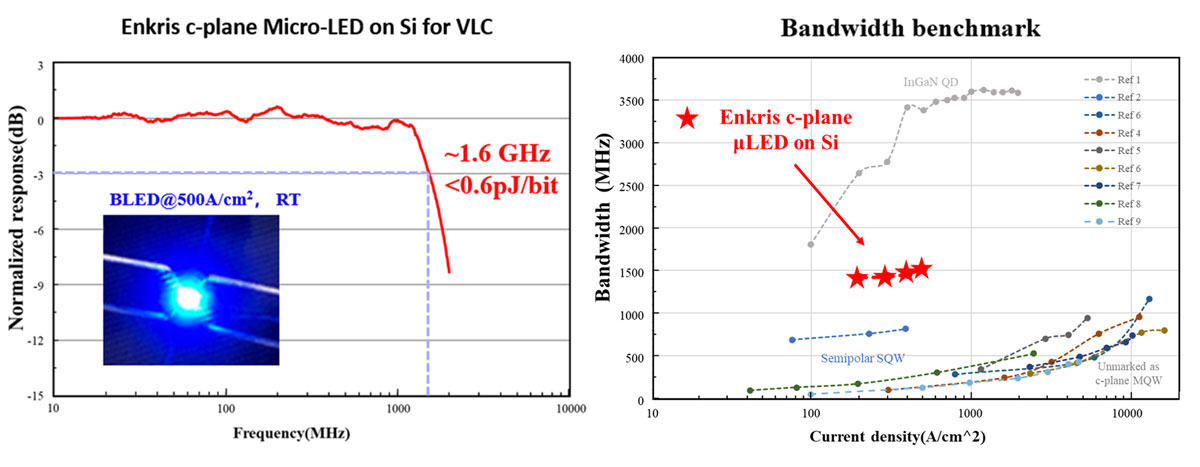
Picture: (Left) Measured S21 curve of Enkris’ micro-LED bandwidth. (Right) Micro-LED light-source bandwidth benchmark.
Leveraging years of accumulated expertise in GaN epitaxy and a CMOS-compatible micro-LED process flow, Enkris says it has optimized the epitaxial structures, material qualities, defects in the active region, and device design. By effectively suppressing the quantum-confined Stark effect (QCSE) in the quantum wells, the carrier recombination rate is significantly enhanced. In addition, the active region area has been reduced to lower device capacitance and minimize RC delay issues.
In the collaboration between team of Enkris and professor Lu Shulong's research group at Suzhou Institute of Nano-Tech and Nano-Bionics,Chinese Academy of Sciences, a –3dB cut-off frequency of 1.6GHz was achieved under an ultra-low current injection condition of 500A/cm2, with device power consumption below 1pJ/bit, placing it at an industry-leading level, it is claimed.
Using, 8”/12” micro-LED on silicon with high bandwidth paves the way for optical device integration on advanced-node CMOS by using mature W2W or D2W bonding, says Enkris. This technology is compatible with existing hardware architectures and mainstream communication protocols used in high-bandwidth memory, precisely filling the gap in short-range transmission. With its advantages of low power consumption, low heat generation, and no electromagnetic interference, it can accelerate the adoption of micro-LED short-distance interconnects in data centers, reckons Enkris.
Enkris and Incize enter strategic partnership
Enkris releases Full Color GaN products and expands wafer size to 300mm for micro-LED applications