

News: Microelectronics
20 July 2026
Jilin University achieves record 2DEG mobility for N-polar GaN/AlGaN heterostructures on SiC
Researchers at Jilin University in China have reported a significant enhancement in the two-dimensional electron gas (2DEG) mobility of nitrogen-polar (N-polar) GaN/AlGaN heterostructures grown on silicon carbide (SiC) substrates by metal-organic chemical vapor deposition (MOCVD) [Ma et al., Appl. Phys. Lett. 128, 072101 (2026)]. The team achieved a 2DEG mobility of 1947cm2/V·s, which is claimed to be the highest value reported to date for N-polar GaN/AlGaN heterostructures on SiC.
The breakthrough addresses a long-standing challenge in realizing high-performance N-polar GaN high-electron-mobility transistors (HEMTs) for high-frequency millimeter-wave applications.
N-polar GaN HEMTs offer significant advantages over their metal-polar counterparts in the W-band (75–110GHz), with reported output power densities up to 8W/mm — nearly double that of metal-polar devices in this frequency range. However, MOCVD-grown N-polar GaN typically suffers from rougher surface morphology and substantially higher oxygen impurity concentrations (around 1018cm-3, one order of magnitude higher than metal-polar films), both of which degrade 2DEG mobility through interface roughness scattering and ionized impurity scattering.
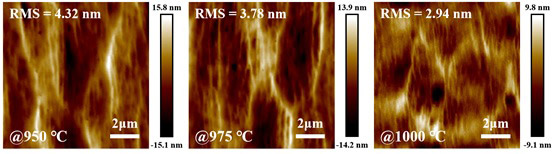
Led by corresponding author Yuantao Zhang and Gaoqiang Deng, the team tackled this problem by varying the growth temperature of the high-resistance GaN (HR-GaN) template layer between 950°C and 1000°C. Counterintuitively, while lowering the HR-GaN growth temperature increased surface roughness — root mean square (RMS) roughness over a 10x10μm2 area rose from 2.94nm to 4.32nm — the 2DEG mobility actually improved significantly, from 1468cm2/V·s to 1947cm2/V·s.
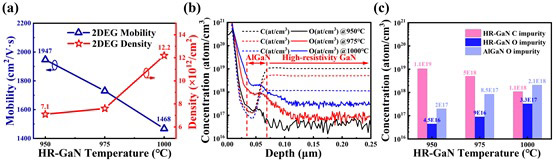
Secondary-ion mass spectrometry (SIMS) analysis revealed the underlying mechanism: reducing the HR-GaN growth temperature from 1000°C to 950°C increased carbon incorporation in the HR-GaN layer by an order of magnitude (from 1.1x1018cm-3 to 1.1x1019cm-3), while oxygen concentration dropped from 3.3x1017cm-3 to 4.5x1016cm-3. The researchers explain that, under Ga-rich growth conditions, carbon atoms preferentially occupy nitrogen sites, competitively suppressing oxygen incorporation. The reduced oxygen concentration in the AlGaN barrier layer — which decreased from 2.1x1018cm-3 to 2x1017cm-3 — weakens ionized impurity scattering, the dominant mobility-limiting mechanism.
A semi-quantitative analysis based on Matthiessen's rule shows that the 10.5-fold suppression of ionized impurity scattering outweighs the 2.2-fold degradation from increased roughness, confirming that impurity control is the dominant factor. Additionally, the higher carbon concentration in HR-GaN increases its sheet resistance from 7.8x10⁵Ω/sq to 9.1x10⁸Ω/sq, which not only suppresses leakage current but also contributes partially to the measured mobility enhancement through a parallel conduction effect.
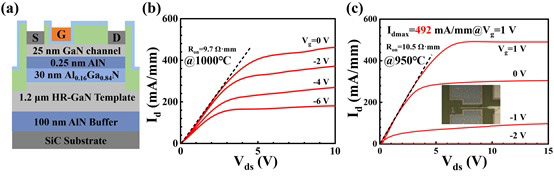
To verify the device-level impact, the team fabricated N-polar HEMTs with HR-GaN grown at both temperatures. The device with HR-GaN grown at 950°C achieved full pinch-off at VGS = −2V and delivered a saturation current density of 492mA/mm at VGS = 1V, whereas the device with HR-GaN grown at 1000°C could not be fully pinched-off even at −6V due to buffer leakage.
“This work demonstrates an effective approach for enhancing the 2DEG mobility in N-polar GaN/AlGaN heterostructures, and holds significant implications for advancing high-performance N-polar GaN HEMT devices,” the team concludes.