

News: Suppliers
13 January 2026
Swansea’s CISM to lead new UK Centre for Doctoral Training in semiconductor skills
Swansea University is to lead a major national initiative to address the UK’s semiconductor skills gap with the launch of a new Centre for Doctoral Training (CDT) in semiconductor skills.
The UK Semiconductor Industry Future Skills (UK-SIFS) CDT will be led by Swansea University’s Centre for Integrative Semiconductor Materials (CISM) in close collaboration with the University of Leeds, and is backed by the UK Government Department for Science, Innovation and Technology as part of its broader Industrial Strategy.
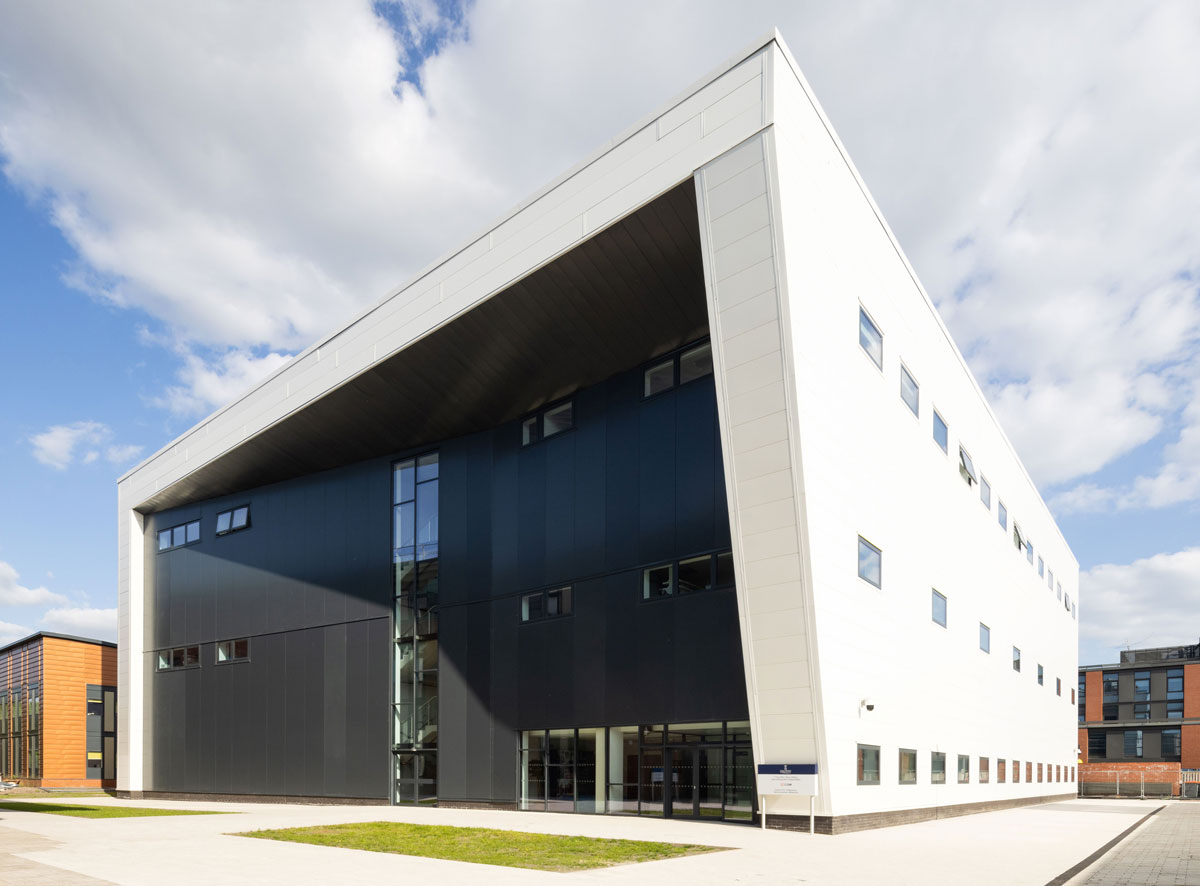
Picture: The CISM building at Swansea University’s Bay Campus.
The CDT will deliver advanced doctoral-level training in semiconductor skills that are critical to the UK’s ambitions for a resilient and competitive semiconductor manufacturing sector.
By combining rigorous academic research with industry-embedded training, UK-SIFS aims to produce a pipeline of up to 60 highly skilled PhD students over five cohorts, who will be equipped to drive innovation and meet the technical demands of next-generation semiconductor technologies.
Students will engage in four-year research projects in partnership with leading UK companies in semiconductors and related sectors. The program will offer flexible training pathways, including part-time study and opportunities for professionals to undertake research projects with their current employers while continuing their professional development. A key focus will be on retraining talent from other high-skill industries where opportunities are diminishing to ensure a robust and adaptable workforce for the future.
UK-SIFS represents a joint investment of about £18m, including £10m from the UK Government Department for Science, Innovation and Technology with additional contributions from Swansea University, the University of Leeds, and 24 industry and civic mission partners.
Training and research will take place in cleanroom facilities at Swansea’s CISM and the Bragg Centre for Materials Research at Leeds – which together represent over £80m in investment. These facilities are designed to be industrially relevant, offering services such as start-up incubation to further support the UK semiconductor ecosystem.
“UK-SIFS is a completely different way of thinking about doctoral training for the UK semiconductor sector – flexible, practical training coupled with industrially relevant, world-class research,” says professor Paul Meredith, CISM director and UK-SIFS co-director.
“UK-SIFS will support a wide range of cutting-edge projects from across science and engineering, training the future highly skilled and diverse workforce needed by the semiconductor sector,” says UF-SIFS co-director professor Edmund Linfield, director of the Bragg Centre for Materials Research at the University of Leeds.
“We need to accelerate and diversify workforce provision, and this is especially important to support rapid growth of the semiconductor manufacturing Cluster in South Wales, driven by significant investment by multi-nationals such as Vishay, KLA, Microchip and IQE,” comments Howard Rupprecht, managing director of CSconnected Ltd.
“The UK:SIFS CDT announcement marks the beginning of a hugely exciting and vital investment in the future of the UK’s semiconductor capability and the next generation of world-leading scientists in the area,” believes professor Charles JM Footer, QinetiQ Fellow. “At QinetiQ, we recognise the strategic importance of developing a highly skilled workforce to support sovereign advanced manufacturing and national security, and we look forward very much to collaborating with the CDT.”
CISM at Swansea establishes UK’s first capability for 4-inch gallium oxide thin-film growth
Wolfson grant to boost Swansea University’s Centre for Integrative Semiconductor Materials