

News: Optoelectronics
19 February 2026
Ultraviolet superluminescent diodes
University of Michigan Ann Arbor in the USA has claimed the first ultraviolet (UV) superluminescent diodes (SLDs) with aluminium gallium nitride (AlGaN/GaN)-based multiple quantum wells (MQWs), emitting at a wavelength of 360nm [Huabin Yu et al, ACS Photonics, v13, p682, 2026]. The optical output power and external quantum efficiency (EQE) reached 8mW and 7.6%, respectively, at room temperature in continuous wave (CW) mode under a current density of 3.5kA/cm2.
The researchers comment: “These results represent a significant advancement in III-nitride light-emitting devices, paving the way for UV superluminescent light sources for applications such as UV optical communications, photolithography, and medical imaging.”
SLDs depend on both spontaneous and stimulated photon emissions, in contrast to the extremes of spontaneous emissions from light-emitting diodes and stimulated emissions from laser diodes. The intermediate nature of SLDs combines the beam directionality of laser diodes with the broadband emission of LEDs.
The team points out: “This unique combination of different emission processes endows SLDs with several promising features including high optical output power, low speckle noise and reduced efficiency droop. Thanks to these specific light properties, SLDs have huge potential for the applications including fiber-optic gyroscopes, micro-display, optical communications, and medical imaging systems such as optical coherence tomography.”
SLDs have been explored at longer visible wavelengths (e.g. 420nm), but not previously in the UV range. State-of-the-art UV LEDs typically have EQEs less than 10%, and the Michigan SLD falls within this window. The team believes that performance enhancement could come from optimizing the heterostructure design, device geometry, thermal management, and packaging.
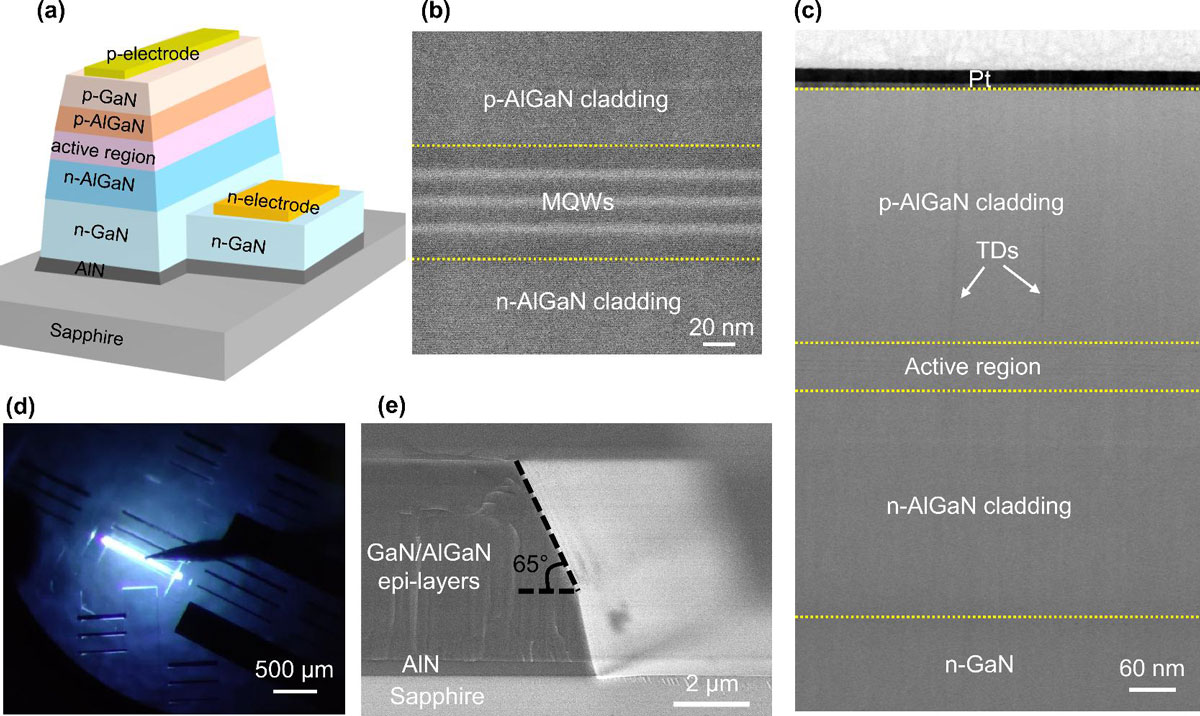
Figure 1: (a) UV SLD structure scheme. Cross-sectional scanning transmission electron microscope (STEM) images: (b) MQW active region; and (c) complete UV SLD structure. (d) Optical image. (e) Cross-sectional SEM image of waveguide.
The device material was grown by molecular beam epitaxy on c-plane sapphire (Figure 1). The active region consisted of a 3-period multiple quantum well (MQW) structure with 12nm Al0.15Ga0.85N barriers and 6nm GaN wells. The same AlGaN barrier composition was used for the upper and lower cladding/guiding layers, 300nm and 330nm thick, respectively. STEM inspection showed very low threading dislocation (TD) density.
The SLD was fabricated from the epitaxial material using plasma etching for the ridge waveguide and device mesa, electron-beam evaporation of the metal electrodes, and passivation with plasma-enhanced chemical vapor deposition silicon dioxide.
By dicing along the cavity length, the bevel angle of the end facets was found to be about 65° from SEM inspection, consistent with the (10-11) plane of the GaN crystal structure. The slanted facets prevent a Fabry–Pérot cavity being formed, thus avoiding laser action.
The peak wavelength of the SLD under current injection was around 360nm (Figure 2). The full-width at half maximum (FWHM) of the emission line was around 6nm.

Figure 2: (a) EL spectra of SLD under CW injection currents at room temperature. (b) Current density–voltage curves. (c) Optical power and external quantum efficiency (EQE) versus CW injection current.
The team reports: “No distinct longitudinal mode peaks are observed, indicating the absence of optical feedback and validating the superluminescent nature of the devices. A secondary emission band appearing at longer wavelengths (~370nm) is attributed to defect-related radiative recombination, which becomes pronounced at high current densities due to carrier leakage into the surrounding n-GaN and p-AlGaN layers. Such parasitic emission can be suppressed by utilizing separate-confinement heterostructures.”
The turn-on voltage of the device was 5.5V. The light output power behavior showed a transition from spontaneous (regime I) to amplified spontaneous emission (ASE, II). With just spontaneous emission one expects a linear relation between current injection and light power. ASE provides a faster-than-linear increment to the optical output power.
The output power reached 8mW at 3.5kA/cm2 current density. The EQE and wall-plug efficiency (WPE) increased to 7.6% and 3.5%, respectively, at the maximum current injection.
The researchers note: “No efficiency droop is observed as the injection current density increases. This behavior is attributed to the unique ASE process of SLDs, where the EQE tends to increase, rather than decrease, at relatively high current densities. Consequently, the droop-free performance of the UV SLDs highlights their potential for solid-state lighting and other high-power ultraviolet applications.”
Ultraviolet superluminescent diodes AlGaN GaN
https://doi.org/10.1021/acsphotonics.5c02007
The author Mike Cooke is a freelance technology journalist who has worked in the semiconductor and advanced technology sectors since 1997.