

News: Optoelectronics
2 February 2026
Distributed polarization-doped green laser diodes
Researchers based in China have improved the performance of green (500–565nm) laser diodes with distributed polarization-doped (DPD) p-type aluminium gallium nitride (AlGaN) cladding [Fangzhi Li et al, J. Appl. Phys., v139, p034501, 2026].
Green laser diodes are sought particularly to fill the ‘green gap’ for efficient laser displays. Other applications using green lasers include underwater communication, and atomic clocks.
The team from Suzhou Institute of Nano-tech and Nano-bionics, Suzhou GaN Bright Optoelectronics Technology Co Ltd, and Sichuan University, improved both from their previous work and in comparison with a device using a conventionally doped AlGaN/GaN superlattice cladding layer.
The DPD uses a graded AlGaN composition between the waveguide and p-GaN contact layers. The variation in the charge polarization of the chemical bonds creates holes that can be injected to recombine in the active photon-producing region, in this case two quantum wells of indium gallium nitride (InGaN) for green light.
The DPD structure has been effective in enhancing the performance of deep ultraviolet (sub 300nm wavelength) laser diodes, where conventional magnesium (Mg) p-type doping has much lower effectiveness for AlGaN than for pure GaN. The team’s previous work using an AlGaN DPD upper cladding did reduce the threshold current, but suffered from a very low slope efficiency. The slope efficiency measures the increase in light output power relative to increases in injection current.
The new structure included a p-doped electron-blocking layer (EBL), boosting the slope efficiency for a slight increase in threshold.

Figure 1: Epitaxial structure of three green laser diodes, (a) conventional green laser diode using 300nm p-Al0.07GaN0.93/GaN superlattice (SL) cladding layer (CL), (b) structure using graded u-AlGaN CL without electron-blocking layer (EBL), (c) laser diode using graded u-AlGaN CL and EBL.
The researchers used metal-organic chemical vapor deposition (MOCVD) on c-plane free-standing GaN substrate to produce their laser diode structures (Figure 1). Magnesocene (Cp2Mg) and silane (SiH4) were used as the p- and n-type doping sources, respectively. While the cladding layers were intentionally p-doped in the conventional laser diode A, the graded claddings for laser diodes B and C were not. Laser diode C was found by secondary-ion mass spectroscopy (SIMS) to have magnesium (Mg) contents of about 5x10¹⁸/cm3, due to the MOCVD memory effect from the preceding p-AlGaN EBL, according to simulations.
Table 1: Hall measurement results of p-CL types.
CL types |
Thickness | Bulk resistivity | Hole mobility | Hole concentration |
| p-Al0.07Ga0.93N/GaN SLs with EBL | 300nm | 0.96Ω-cm | 7.72cm2/V-s | 8.38x10¹⁷/cm3 |
| graded u-Al0.15-0.02GaN without EBL | 150nm | 1.66Ω-cm | 9.83cm2/V-s | 2.23x10¹⁷/cm3 |
| graded u-Al0.14-0GaN with EBL | 150nm | 0.967Ω-cm | 8.71cm2/V-s | 7.41x10¹⁷/cm3 |
The p-contact layers were coated with transparent conductive indium tin oxide (ITO), which the team used to enhance the optical field confinement on the p-type side of the laser diodes. The 200nm ITO layer was also expected to improve optical field confinement on the p-side of the laser diodes, pushing the peak intensity towards the n-side.
Table 2: Threshold and slope efficiencies. Result for B is from previous report from group.
LD- |
Threshold current density | Slope efficiency |
| A | 2.28kA/cm2 | 0.49W/A |
| B | 1.7kA/cm2 | 0.07W/A |
| C | 1.83kA/cm2 | 0.54W/A |
The researchers performed Hall measurements to assess the hole transport properties of the p-type cladding layers (Table 2). Without the EBL, the graded cladding layer had an increased resistivity due to a severe reduction in hole concentration, not compensated by the increase in mobility. Including the p-doped EBL marginally increases the bulk resistivity while improving the mobility over the conventional SL structure with a slight drop in hole concentration.
The researchers comment: “Unintentionally doped Mg acceptors can significantly reduce the resistivity of graded AlGaN cladding layers, which helps reduce the operating voltage of laser diodes.”
The team comments on simulated optical loss rates: “Unionized Mg acceptors are the main cause for internal loss in laser diodes, so in LD-B and LD-C with lower Mg doping concentrations, the internal loss is lower, 2.10/cm and 2.44/cm, respectively. LD-A has the highest Mg doping concentration, so its internal loss is also the highest, reaching 2.97/cm.”
In the previous work, the researchers reported that the LD-B structure suffered from severe reduction in slope efficiency, measured at just 0.07W/A. The team’s simulations suggest that this was due mainly to electron overflow into the p-type region, rather than contributing to photon generation in the multiple quantum well region.
The absence of the EBL also results in “the disadvantage of high operating voltage, which is attributed to the abnormally low injection efficiency,” the team comments, adding: “Some reports suggest that the low injection efficiency is caused by the polarization charges at the sharp interface between the InGaN upper waveguide and AlGaN cladding layer, which hinders hole transport.”
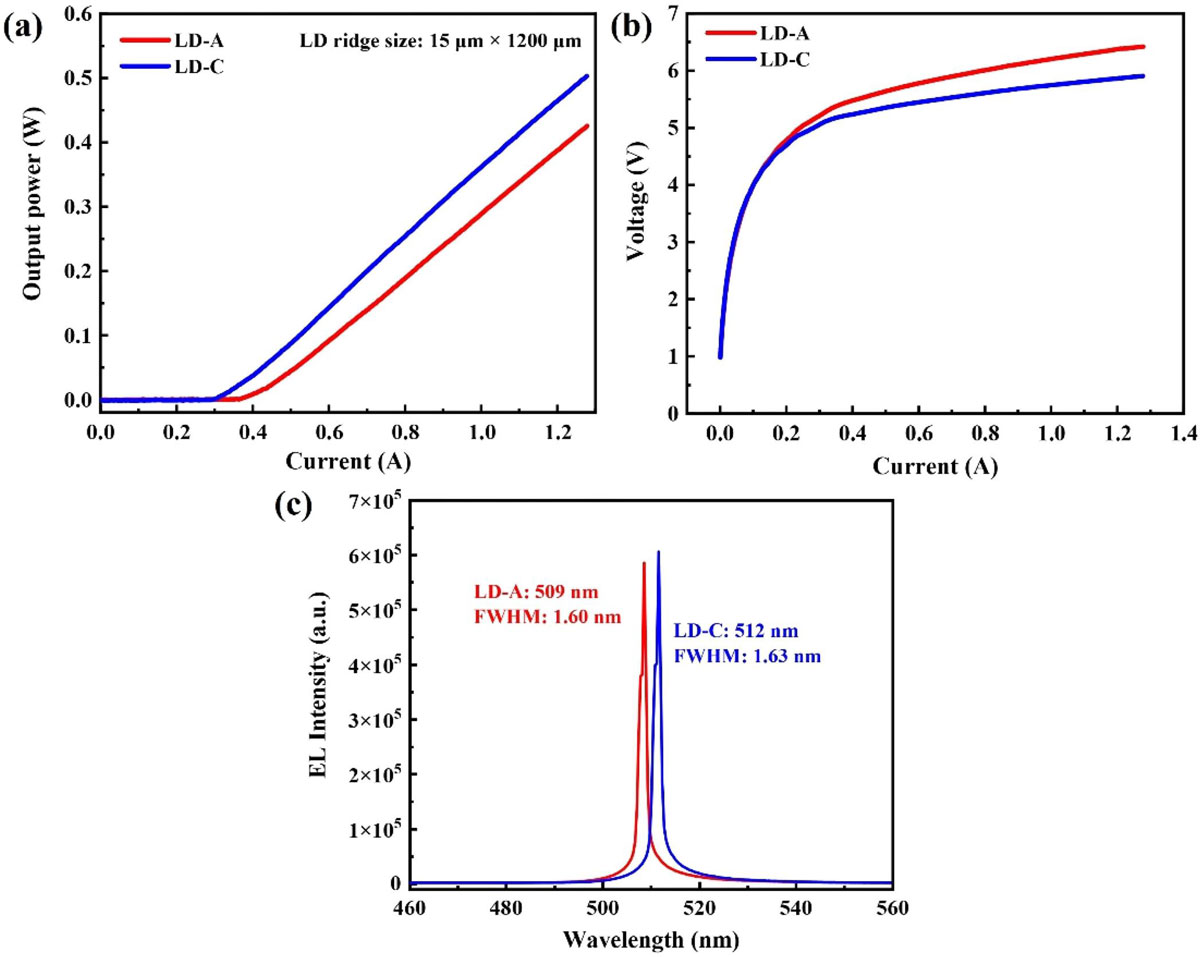
Figure 2: (a) Optical power–current curves of LD-A and LD-C chips measured under pulse operation, (b) current–voltage characteristics, and (c) lasing spectra.
The researchers fabricated laser diodes based on the conventional and C epitaxial structures (Figure 2). The peak lasing wavelengths were at 509nm and 512nm for LD-A and -C, respectively.
LD-C under pulsed injection achieved lower threshold currents, and higher slope efficiency, (along with lower operating voltage, according to Figure 2) than LD-A (Table d). LD-B did achieve a slight lowering of the threshold from LD-C, but at the cost of much reduced slope efficiency, previously mentioned.
Laser diodes Green laser diodes DPD p-type AlGaN cladding
https://doi.org/10.1063/5.0306105
The author Mike Cooke is a freelance technology journalist who has worked in the semiconductor and advanced technology sectors since 1997.