

News: Markets
20 August 2026
Power GaN device market growing at 35% CAGR to $3.5bn in 2031, driven by data centers, EVs and industrial systems
Power gallium nitride (GaN) has spent the past several years proving itself in consumer fast chargers, but that phase is ending, according to Yole Group’s annual report ‘Power GaN 2026’. GaN is now entering a broader, multi-market adoption cycle where AI data centers, electric vehicles, industrial systems, and renewable energy all become meaningful demand drivers. For chipmakers, foundries and investors, understanding where this next wave of growth is concentrated and which companies are positioned to capture it is critical to strategic planning over the next five years.
“For years, power GaN’s story was almost entirely about the phone charger in your pocket. That’s no longer the full picture,” notes Roy Dagher PhD, technology & market analyst, Compound Semiconductors, at Yole Group. “AI infrastructure is opening a second, arguably bigger chapter for this technology, and it’s moving fast.”
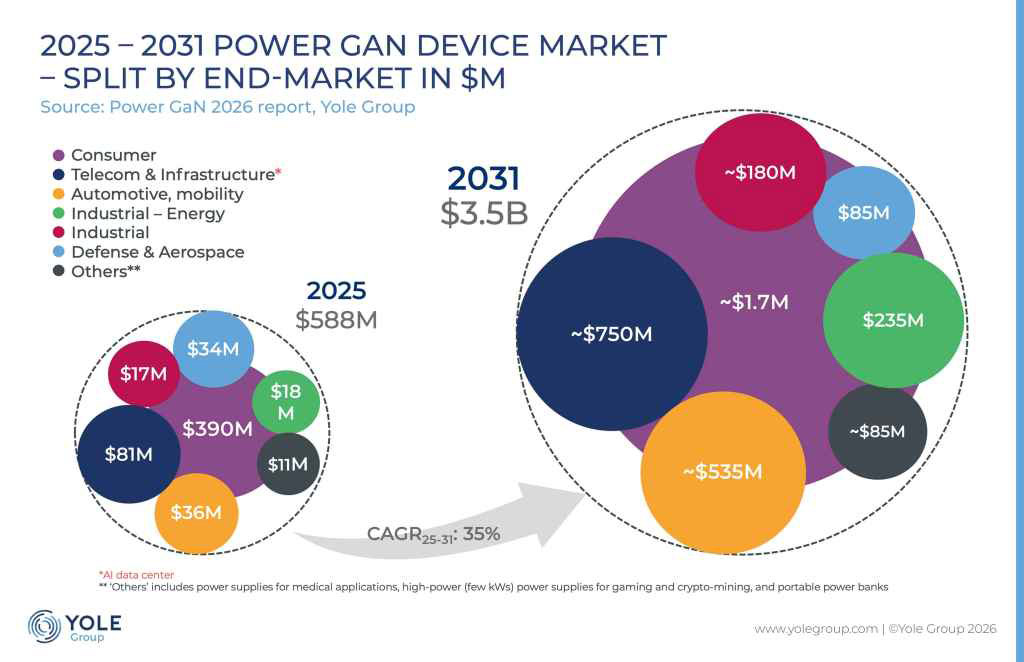
Consumer and mobile electronics remain the market’s anchor segment by revenue, expected to reach $1.7bn in 2031 due to continued fast-charger and appliance adoption. But the sharpest growth curve belongs to automotive, where onboard chargers and emerging 48V architectures push the segment to a compound annual growth rate (CAGR) of 57%, and to telecom/infrastructure, where AI-driven data-center demand drives a 45% CAGR to $750m.
Further out, humanoid robots stand out as a potential growth engine beyond 2030. Actuator drives and battery management in a humanoid platform all call for high power density within tight weight and thermal budgets – the conditions where GaN’s efficiency and small form factor matter most. Volumes are negligible today but, if humanoid platforms reach commercial scale in the 2030s, they would add a demand pool distinct from consumer, automotive and data-center applications.
GaN competition proliferating as adoption spreads
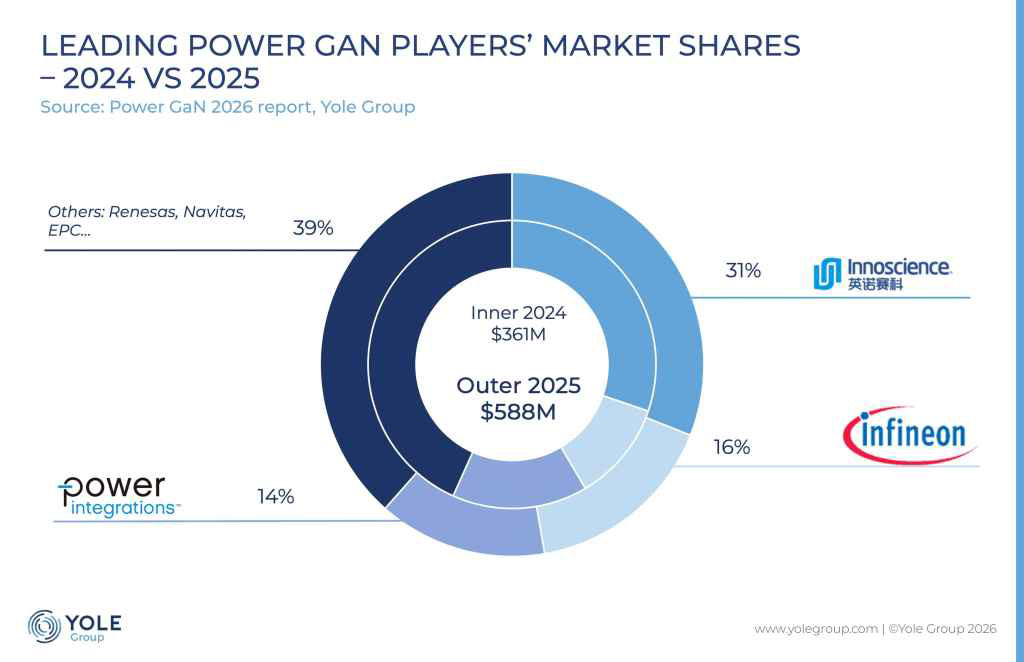
The competitive landscape is shifting too. Innoscience held the top spot in 2025 and continues to widen its footprint into automotive and data centers. Infineon Technologies posted the year’s sharpest gains on the back of data-center and renewable energy wins, and Renesas kept expanding across multiple fronts. Navitas took a different path, deliberately trading share in low-margin fast-charging for a foothold in higher-value segments.
onsemi is the most significant new entrant: it moved into power GaN through a collaboration with GlobalFoundries on 650V devices built on a 200mm GaN-on-silicon platform, alongside a parallel wafer-supply arrangement with Innoscience, with customer sampling starting in first-half 2026 and AI data centers, EVs and renewable energy as its stated targets.
Behind the leaders, a fast-growing group of suppliers – ROHM, Texas Instruments, STMicroelectronics, Nexperia, and Chinese entrants including GaNext and Southchip – is picking up share as GaN spreads to more corners of the industry.
Manufacturing base diversifying
The manufacturing shift is one of the report’s central findings. Rather than consolidating around a single dominant foundry, the industry is fragmenting productively: GlobalFoundries has licensed GaN technology from TSMC and is qualifying production in the USA, Taiwan-based Vanguard International Semiconductor Corp (VIS) and Powerchip Semiconductor Manufacturing Corp (PSMC) are absorbing volume as customers move off TSMC, and Samsung, DB HiTek, and SK Keyfoundry are each building early GaN capabilities in South Korea. At the same time, IDMs including Infineon, Renesas, onsemi, STMicroelectronics, ROHM and Nexperia continue to invest in their own capacity and vertical integration, often through acquisition.
“TSMC stepping back from GaN foundry work could have been read as a warning sign for the industry. Instead, it’s turning into one of the clearest signals of how much this ecosystem has matured,” says Poshun Chiu, principal technology & market analyst, Semiconductor Substrates & Materials, at Yole Group. “Other foundries are moving in fast, and the manufacturing base is coming out more distributed than before.”