

News: LEDs
4 August 2026
UV LED reaches 19% wall-plug efficiency at 298nm
University of California Santa Barbara in the USA claims the highest reported wall-plug efficiency (WPE) yet for ultraviolet light-emitting diodes (UV LEDs) around 298nm wavelength [Wenting Gong et al, IEEE Electron Device Letters, published online 3 June 2026]. The team also included a researcher associated with King Abdulaziz City for Science and Technology in Saudi Arabia.
The peak WPE reached 19.0% at 0.09A/cm2 injection current. At higher 10A/cm2 injection, the WPE drooped to 7.4%, but was still higher than most other reports at this wavelength range.
The III−nitride semiconductor development community is seeking to displace conventional mercury lamps, which in addition to containing a highly toxic element in a fragile enclosure, are bulky and have short lifetimes. However, UV LEDs at shorter wavelengths, less than 300nm, have WPEs less than 10%, let alone reaching the 25% of mercury lamps.
The epitaxial material for the UV LED was grown by metal-organic chemical vapor deposition on AlN/sapphire templates (Figure 1). The magnesium-doped p-side of the device included an electron-blocking layer (EBL), p-AlGaN superlattice, and finally p-GaN.
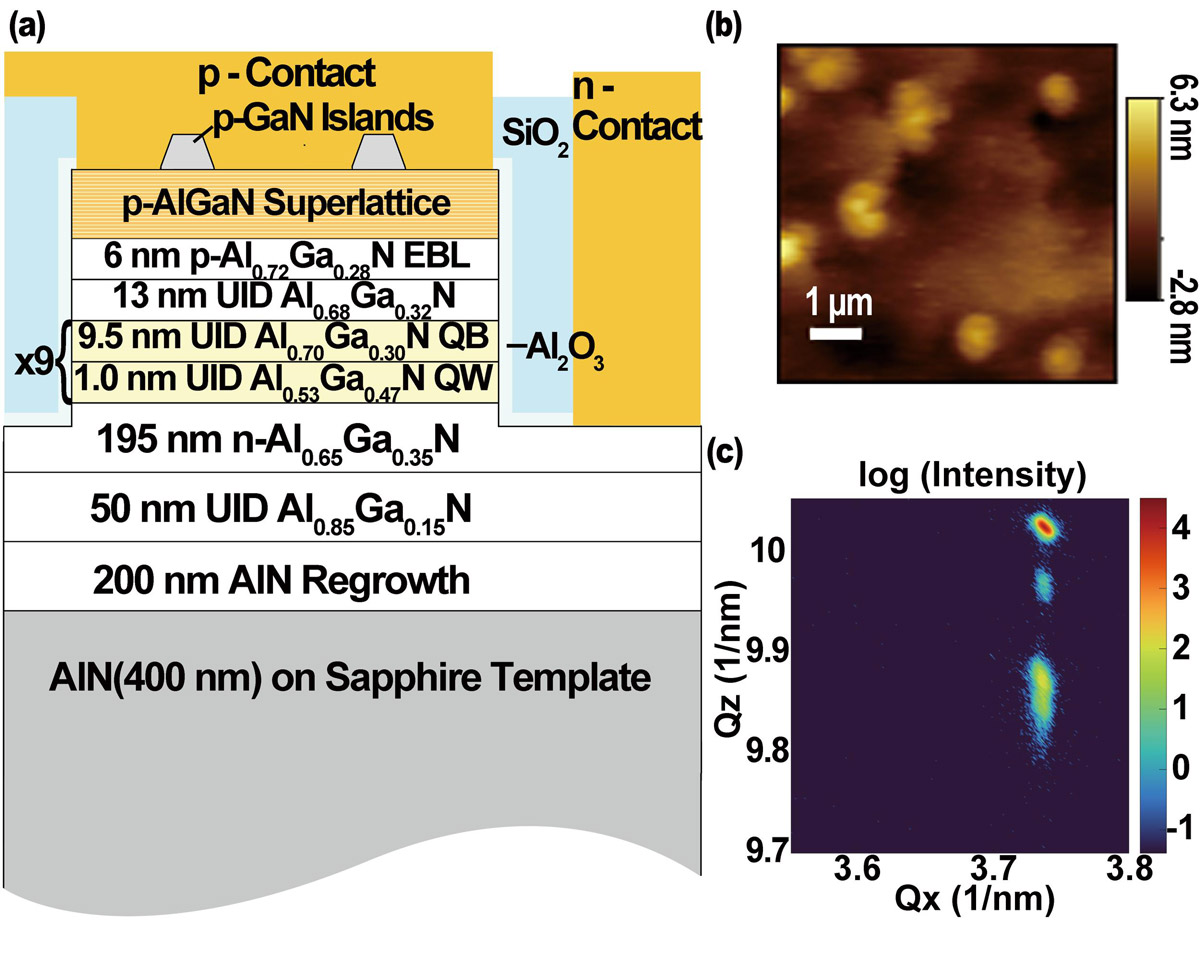
Figure 1: (a) Schematic UV LED cross section. (b) Atomic force microscopy (AFM) image of epitaxial sample surface with p-GaN islands. (c) X-ray diffraction (XRD) reciprocal space mapping (RSM) at (101−5) reflection.
Since p-GaN absorbs UV radiation, the researchers used Volmer−Weber island growth for the contact layer, rather than the more usual layer growth used for the AlGaN layers. The process targeted a low 10% areal island density, with a view to increasing UV light extraction efficiency.
The team comments: “The coherent growth of the AlGaN heterostructure reduces the dislocation density and is therefore expected to suppress Shockley−Read−Hall (SRH) non-radiative recombination.”
The 195nm n-AlGaN contact layer thus enabled optimized current spreading. The coherent AlGaN was also key in forming the p-GaN Volmer−Weber islands due to the high stress at the AlGaN/GaN interface.
Hole injection is a particular problem in III−nitride devices. P-type doping is usually via magnesium impurities. The acceptor level that grabs electrons to form holes in the valence band is even deeper in high-Al-content AlGaN than in pure GaN, which is why most UV LEDs include a p-GaN layer. Unfortunately, GaN strongly absorbs radiation shorter than 365nm by exciting electrons across the 3.4eV bandgap.
The circular LED mesas were etched to a 235nm depth. The device area was 0.1mm2. The n-contacts were vanadium/aluminium/nickel/gold, and p-side metals were nickel/aluminium/nickel/gold. The p-side stack was also designed to be highly reflective of the UV radiation. Passivation consisted of 37nm atomic-layer-deposited aluminium oxide (Al2O3), and 305nm plasma-enhanced chemical vapor deposition silicon dioxide (SiO2). Contact pads were titanium/gold.
The peak wavelength of the LED was around 298nm, falling in the UV-B range (Figure 2). The researchers expect to be able to reduce the reverse current leakage (10−5A/cm2 at −5V bias) by using higher-quality templates or bulk AlN substrates.
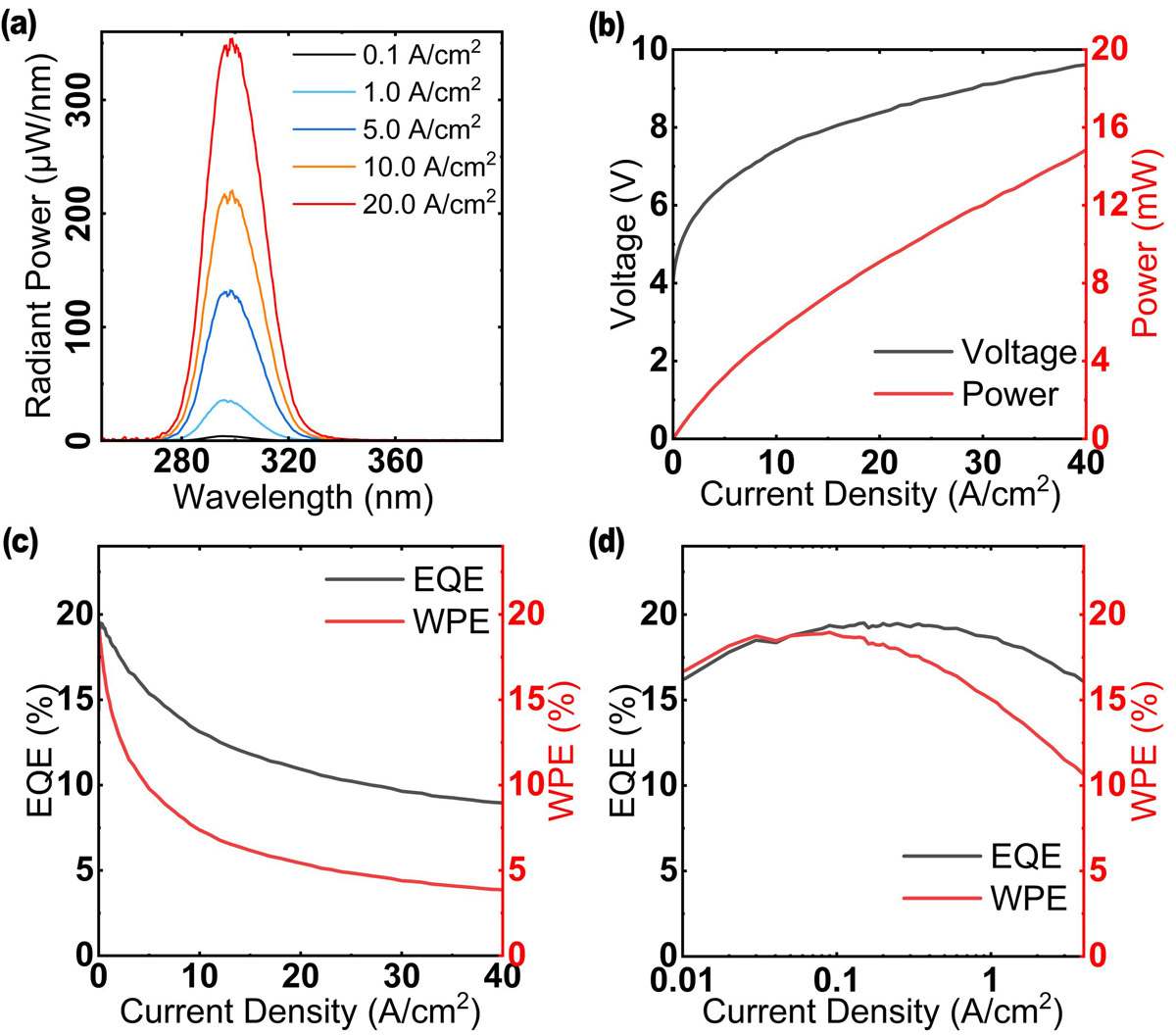
Figure 2: (a) Electroluminescence (EL) spectra under different current densities. (b) Light output power−current density−voltage (L−J−V) plots. (c) External quantum efficiency (EQE) and wall-plug efficiency (WPE) against current density. (d) Zoomed-in view of (c) at low current density with logarithmic x-axis.
The peak 19.5% EQE and 19.0% WPE were reached at 0.15A/cm2 and 0.09A/cm2 injections, respectively.
Although the efficiency droops at more practical injection currents, to 7.4% at 10A/cm2, the researchers comment: “The WPE in our LED devices remains advantageous over most reported AlGaN-based LEDs in this wavelength range.” Indeed, the paper presents a table of 8 reports, including “this work”, showing only one group achieving a higher 9.0% WPE, at 280nm wavelength. The maximum WPE of the competitor was 9.3%.
The 5.5mW output power at 10A/cm2 was only beaten by two groups in the table with 6mW (298nm) and 6.5mW (283nm).
https://doi.org/10.1109/LED.2026.3698638
The author Mike Cooke is a freelance technology journalist who has worked in the semiconductor and advanced technology sectors since 1997.