

News: LEDs
20 August 2026
Weak polarization electric-field c-plane GaN LEDs
Researchers based in China and Saudi Arabia claim the highest external quantum efficiency (EQE) so far for light-emitting diodes (LED) using weak polarization electric field (PEF) multiple quantum well (MQW) structures with effective indium aluminium gallium nitride (InAlGaN) quantum barriers (QBs), achieved through c-plane digital alloy (DA) growth on patterned sapphire substrate [Jingkai Zhao et al. Light: Science & Applications, v15, p300, 2026]. The researchers estimate the PEF in their devices to be as low as 0.5MV/cm, compared with more than 1MV/cm for conventional c-plane GaN MQW structures.
Quaternary InAlGaN material allows tuning of lattice parameters, reducing strain and thus piezoelectric and spontaneous fields. Such fields are known to adversely affect electron-hole recombination into photons, reducing light output power (LOP) and EQE. In particular, the electric field is usually in such a direction as to shift the electrons and holes away from each other in LED structures. This is the quantum-confined Stark effect (QCSE).
Unfortunately direct growth of InAlGaN is tricky and tends to result in low crystal quality and rough surfaces. This is partly attributable to an inability to effectively mix InN and AlN bonds in the same structure due to the different bond lengths. Digital alloying avoids this problem by alternately depositing thin layers of AlGaN and InGaN to give a short-period superlattice with an effective InAlGaN QB structure.
The team from Jilin University and King Abdullah University of Science and Technology (KAUST) optimized the DA process to enable a 15% peak EQE in their best LED.
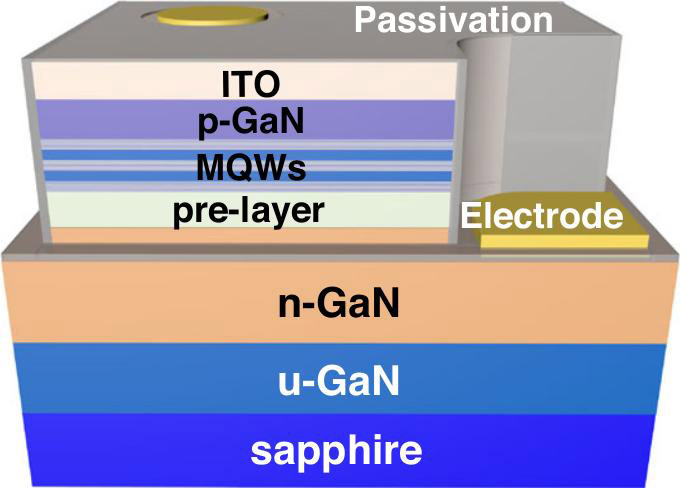
Figure 1: DA-based LED device structure.
The researchers fabricated LEDs with digital-alloy QBs between the MQWs (Figure 1). The devices were produced on 4-inch wafers prepared on sapphire by metal-organic chemical vapor deposition (MOCVD). Trimethyl metal-organic molecules were used for the indium and aluminium precursors. Triethyl-Ga was used for the gallium source, and ammonia (NH3) for nitrogen.
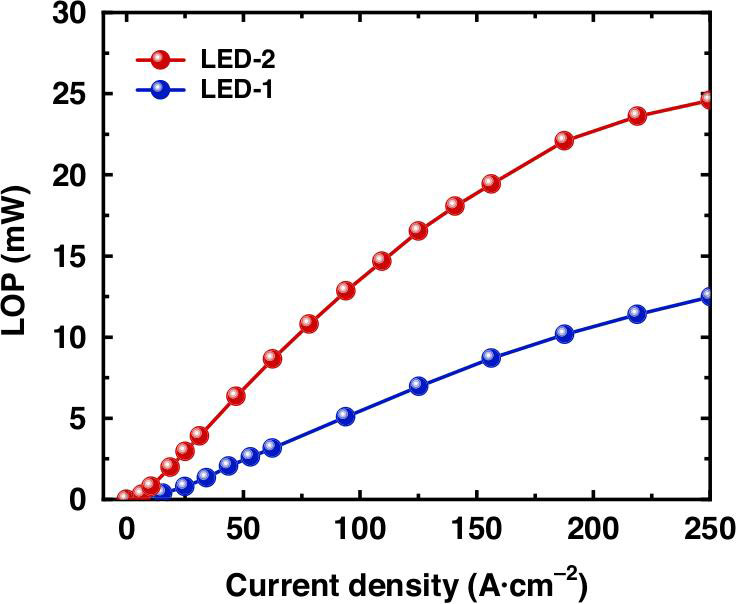
Figure 2: Light output power (LOP) versus injected current density of 147μm×264μm LEDs.
In preliminary studies, the researchers found that reducing the ammonia flow during the InAlGaN quantum barrier (QB) digital alloy deposition improved the material quality for LED light output (Figure 2). The researchers believe that the optimized ammonia delivery scheme effectively suppressed incorporation of additional indium atoms and prevented generation of nitrogen vacancies.
The LED-1 was produced with constant ammonia flow of 20 standard liters per minute (slm) during both the AlGaN and InGaN layer periods of the DA. For LED-2, the ammonia was reduced to 5slm during the Al and Ga pulses used to deposit the AlGaN periods. The QWs consisted of two 2.5nm In0.15Ga0.85N layers grown at 750°C. The QB growth was at 720°C. The DA QB consisted 6 pairs of 1nm/1nm InGaN/AlGaN layers, giving 12nm in total.
The 25.0mW LOP of LED-2 was increased by 97% over that of LED-1 at 250A/cm2 current injection.
The peak EQE of LED-2 reached 15% and remained above 10% up to 250A/cm2 injection (Figure 3). The blue-shift of the peak wavelengths were 0.4nm and 0.3nm for LEDs 1 and 2, respectively. A third LED fabricated with conventional InGaN/GaN MQW material suffered a 5.9nm wavelength shift, demonstrating one effect of not using DAs in conventional PEF structures.
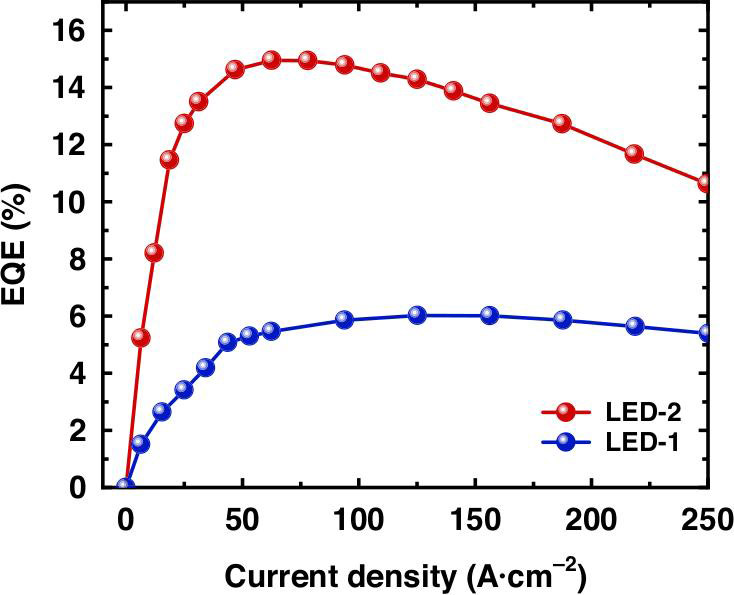
Figure 3: External quantum efficiency (EQE) versus versus injected current density.
The researchers compared their weak PEF LED-2 performance with other reports (Figure 4). The team comments: “It can be observed that LED-2 exhibits the highest EQE (15%) among previously reported heteroepitaxial weak-PEF LEDs grown on polar plane (maximum 8.8%) and nonpolar/semipolar plane (maximum 3.9%). It is only lower than weak-PEF LEDs grown on nonpolar/semipolar planes by homoepitaxy. In this context, although homoepitaxial nonpolar/semipolar weak-PEF LEDs can achieve higher EQE, their reliance on expensive substrates and limited process compatibility makes them less favorable for manufacturing. Taken together, our approach provides a manufacturable weak-PEF route that retains polar c-plane compatibility within heteroepitaxial platforms.”
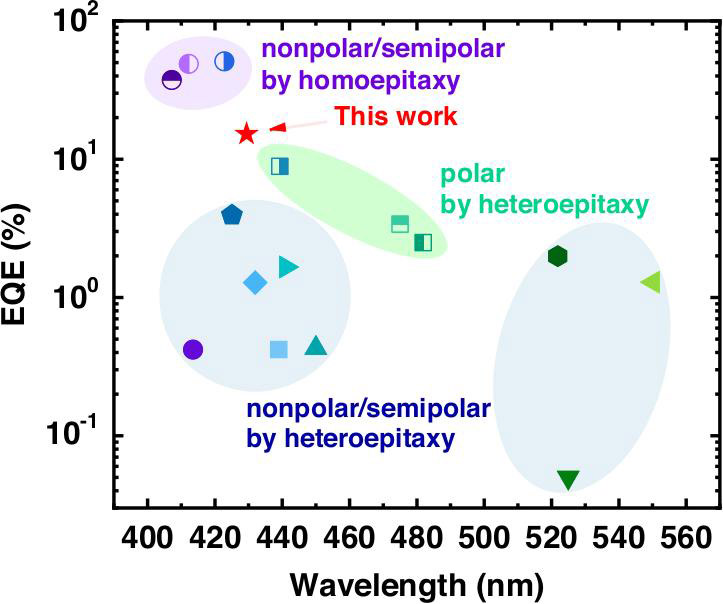
Figure 4: Comparison of the peak EQE of LED-2 and weak-PEF LEDs from other reports.
The researchers also showed that the peak EQE and its corresponding current density shifted less for the digital alloy MQW micro LEDs, compared with LEDs fabricated from conventional InGaN/GaN MQW material (Figure 5). The efficiency of smaller devices tends to degrade due to non-radiative recombination at the sidewalls. Based on these results, the researchers suggest that the weak-PEF LED exhibits an approximate 50% reduction in sidewall sensitivity compared with the conventional LED.
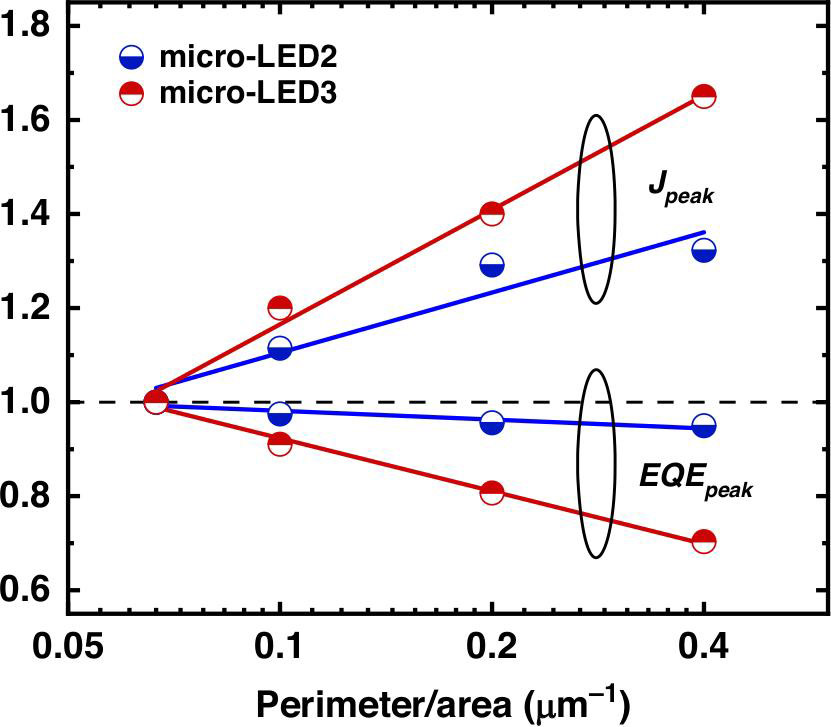
Figure 5: Normalized peak EQE and corresponding current density (J) versus ratio of perimeter to area for square micro-LED-2 and conventional InGaN/GaN MQW micro-LED-3. Values normalized to the results of the largest-size 60μm LED.
The team comments: “Such a characteristic is crucial for micro-LEDs, where strong carrier confinement contributes to mitigate efficiency losses induced by sidewall effects.”
https://doi.org/10.1038/s41377-026-02359-6
The author Mike Cooke is a freelance technology journalist who has worked in the semiconductor and advanced technology sectors since 1997.