

News: Optoelectronics
13 April 2026
Photon Design’s laser design course now part of Cardiff’s physics curriculum
Photonic simulation CAD software developer Photon Design Ltd of Oxford, UK has partnered with Cardiff University to deliver a two-day laser design course as part of its physics curriculum.
Students begin the course with laser theory and end by producing practical laser designs and models. They gain hands-on experience of Photon Design’s CAD software, using its FIMMPROP simulation tool to create laser component designs, circuit simulations, and layouts. Students then progress to Photon Design’s PICWave to produce a complete design workflow with three-dimensional, time-evolving, laser modelling. The course provides hands-on experience of how advanced simulation tools can simplify and accelerate the laser design process, producing functional laser designs within just two days.
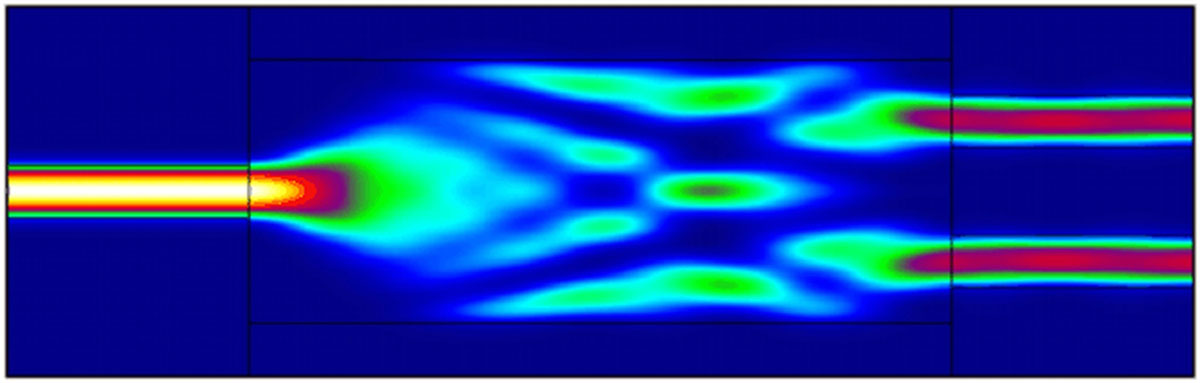
Picture: 3D MMI simulation produced after one day using FIMMPROP EME.
“The unique partnership with Cardiff University gives students valuable, real-world industrial laser design experience, modelling physics in action,” says Photon Design scientific advisor, Alex Edwards, who delivers the course. “Within two days, students produce manufacturable laser designs, clearly demonstrating the simplicity, speed and efficiency of the simulation tools and connecting academic theory to practical industry skills,” he adds.
“The course includes simulating photonic components like MMIs, rings and tapered waveguides with FIMMPROP. Introducing this EigenMode Expansion (EME)-based simulation tool is often pivotal for students, as they experience its impressive speed compared to the more familiar FDTD method. With EME, we conduct equally thorough simulations in seconds, not the hours required by FDTD, making it possible to iterate laser designs efficiently and an essential part of the process,” Edwards continues.
“PICWave offers students many advanced physics effects, essential for modelling cutting-edge lasers. This covers optical mode propagation, thermal effects, carrier diffusion, and how their combined coupling will impact laser gain, ensuring the laser design meets individual application requirements,” he adds.
“Our partnership with Cardiff University provides valuable feedback that helps to enhance our laser simulation products, informing and improving our next-generation of laser simulation tools.”
Photon Design showcasing new HAROLD QD laser simulator and silicon modulator design tool at OFC