

News: Optoelectronics
17 April 2026
Nuvoton releases 4.5W 402nm violet laser, boosting power output by 1.5x
Nuvoton Technology of Kyoto, Japan has announced the start of mass production of the KLC434FL01WW high-power violet laser diode (402nm, 4.5W), which achieves what is claimed to be industry-leading optical output in a 9.0mm-diameter TO-9 CAN package, for continuous-wave (CW) operation at a case temperature (Tc) of 25°C. Due to the proprietary device structure and heat-dissipation design technology, the new product achieves 1.5 times the 3.0W optical output of the firm’s conventional 402nm product in a TO-9 CAN package (the KLC432FL01WW), contributing to improved production throughput in optical equipment such as maskless lithography systems. Furthermore, adding this product to the firm’s lineup enables the product portfolio to support major photosensitive materials used in advanced semiconductor packaging.
The new product expands Nuvoton’s lineup of ultraviolet (378/379nm), violet (402nm) and indigo (420nm) semiconductor laser diodes designed to replace the i-line (365nm), h-line (405nm), and g-line (436nm) emission lines of mercury lamps, providing new options in light source selection.
Boosting 402nm laser power by 1.5x to 4.5W speeds maskless lithography system production throughput
Violet (402nm) laser diodes generally suffer from relatively low wall-plug efficiency and significant self-heating, and are also prone to short-wavelength-induced degradation, which makes stable high-power operation difficult.
To address these challenges, Nuvoton has developed a device structure that enhances wall-plug efficiency (WPE) and high-thermal-conduction package technology that effectively dissipates heat. These technologies were used in the firm’s 379nm, 1.0W high-power ultraviolet laser diode for i-line applications launched in January, and have since been expanded to the violet (402nm) band for h-line applications.
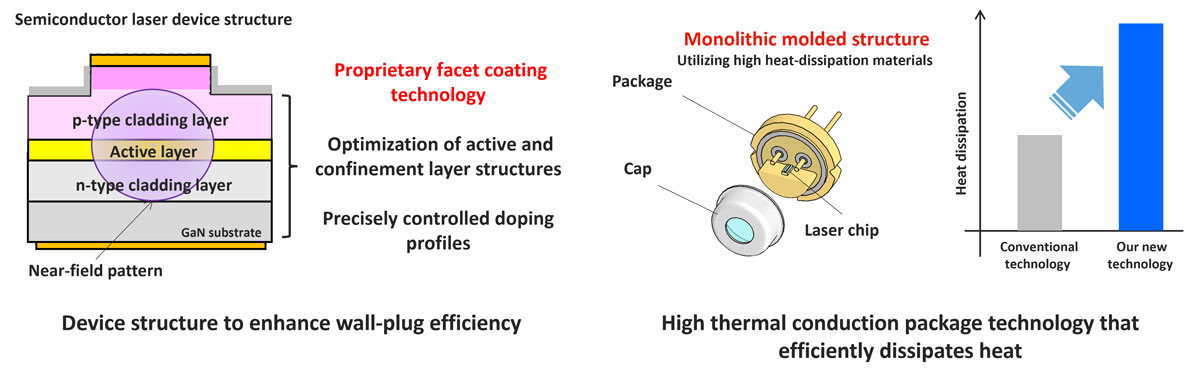
Figure 1: Device structure that enhances wall-plug efficiency and high-thermal-conduction package technology that effectively dissipates heat.
The new 4.5W 402nm violet laser diode achieves 1.5 times the optical output of the prior product by applying the firm’s proprietary facet coating technology (which suppresses degradation factors at the laser facets, improving the lifetime performance during high-power operation). Also, by adopting a monolithic molded structure using high-heat-dissipation materials for the package, Nuvoton has improved heat-dissipation performance.
By achieving both high power and high reliability, the new laser can enhance production throughput in industrial optical equipment where high quality is required, says the firm.
Expanded range of light sources for maskless lithography in advanced packaging supports multiple photosensitive materials
Nuvoton reckons that the new product can deliver significant value in maskless lithography for advanced packaging, a market that is growing rapidly, driven by expanding demand for artificial intelligence (AI) and other applications.
In circuit formation for advanced packages, maskless lithography technology that directly exposes (draws) wiring patterns based on design data has been attracting attention in recent years, as it enables not only cost reduction and development time shortening but also high-precision patterning correction in response to substrate warpage and distortion.
For laser diodes, which are one of the main light sources in maskless lithography technology, there has been demand for compatibility with wavelengths close to the i-line (365nm) and h-line (405nm), which are the emission lines of mercury lamps, in order to correspond to the main photosensitive materials, as well as higher output for the purpose of improving the production throughput of equipment.
Nuvoton says that this expansion of its range of semiconductor laser-based light sources for maskless lithography in advanced packaging from i-line (365nm) to h-line (405nm) mercury lamp replacement enables consistent support for multiple major photosensitive materials while contributing to higher production throughput of equipment.
The h-line (405nm) emission of mercury lamps is used in a wide range of fields such as photocuring, 3D printing, sensing, biomedical applications, and marking. So, Nuvoton says that its new 4.5W 402nm violet laser diode provides a new option as an alternative light source for these applications.
Furthermore, by leveraging its high-power performance, it can contribute to improving the efficiency of processes that were difficult to realize in the past, as well as to creating new optical applications, the firm reckons.
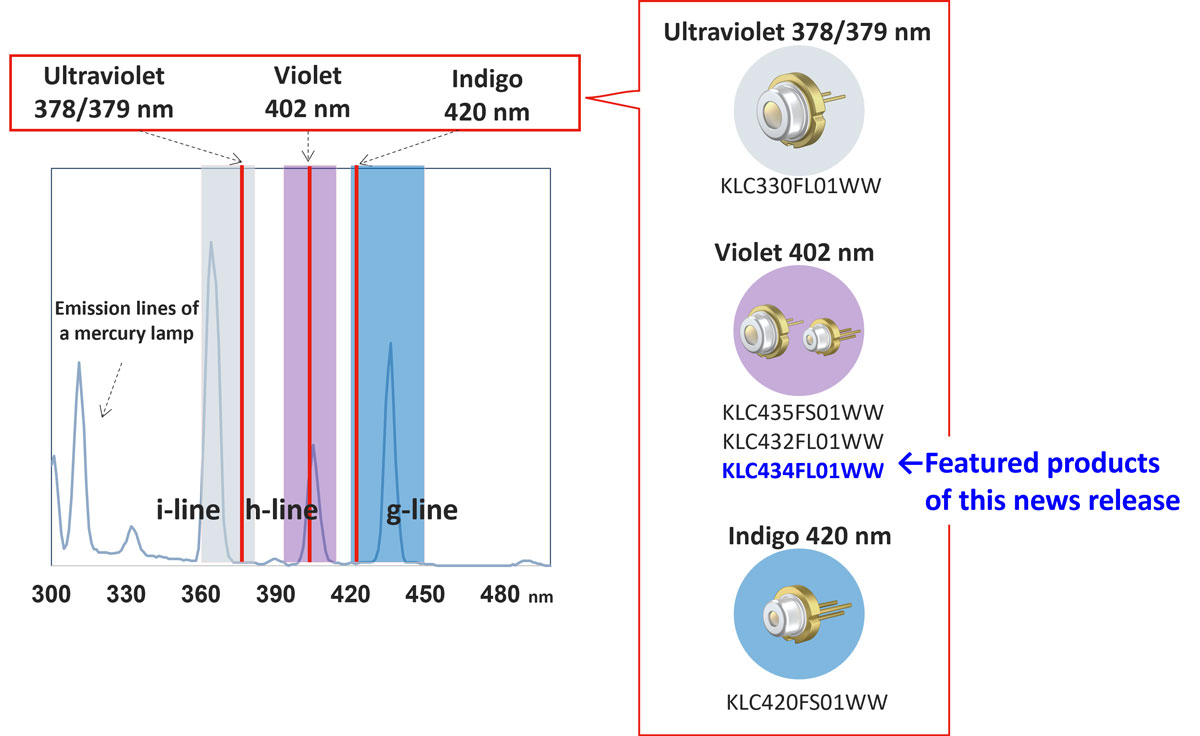
Figure 2: Mercury lamp replacement solution using semiconductor lasers.
The new product is being exhibited at OPIE’26 (OPTICS & PHOTONICS International Exhibition) at Pacifico Yokohama, Japan (22–24 April). Mass production is scheduled to start in May.
Nuvoton releases high-power 1W 379nm UV laser diode
Nuvoton launches compact 1.7W 402nm violet laser in TO-56 CAN package