

News: LEDs
13 April 2026
Marktech launches high-power 280nm UVC LEDs
Marktech Optoelectronics Inc of Latham, NY, USA has made available for order several new 280nm UVC LEDs in single-chip, two-chip and four-chip configurations, designed to accelerate the development and prototyping of UVGI water purifiers, air disinfection systems, and surface sanitizers.
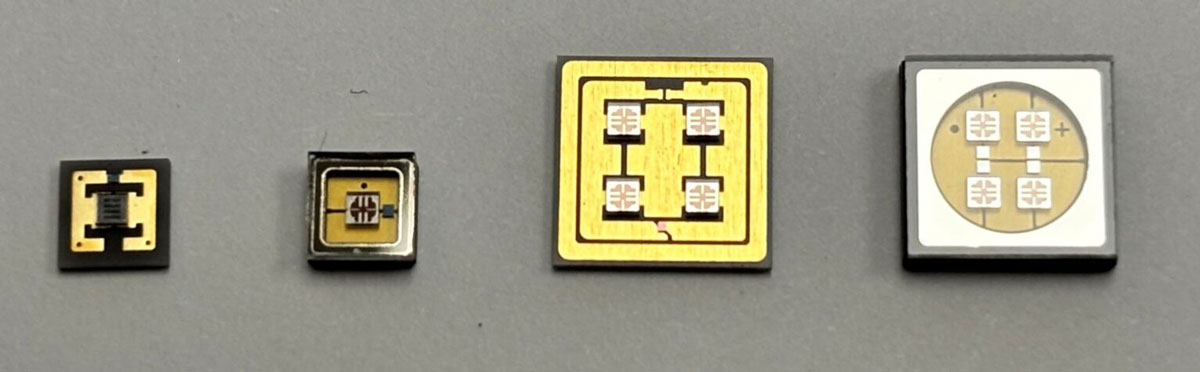
Picture: Single-chip 280nm UVC LEDs: far left, COS/No Lens; second from left, flat lens SMD. Four-chip 280nm UVC LEDs: second from right, COS/No Lens; far right, flat lens SMD.
Advantages of the new 280nm UVC LEDs are cited as:
- High efficiency: Featuring 280nm-emitting chips, the UVC LEDs are claimed to provide outstanding power efficiency, with wall-plug efficiencies of up to 7%.
- Durability and eco-friendliness: The UVC LEDs are designed for longevity, exceeding 15,000 hours at L70.
- Multiple-chip options: Two, four and custom multiple UVC LED chip options enable high optical output in a compact format for demanding disinfection, medical device sterilization, and sanitization applications.
- Versatile applications: 280nm UVC LEDs are suitable for a diverse range of uses such as medical equipment, gas monitors, water quality sensors, DNA purity analyzers, UVGI air systems, water purifiers, surface sanitizers, and consumer appliances.
Marktech notes that 280nm UVC LEDs are key components in a wide array of applications, including water quality sensors, DNA purity or protein analyzers, UV-visible spectrometers, UV illuminators, upper-air disinfection systems, UV tower surface sanitizing robots, and UVC water purifiers, across both industrial and consumer product sectors.
Key applications of 280nm-wavelength UVC light are cited as:
- Biochemistry & proteomics: Used in spectrophotometers (such as Nanodrop) to measure protein concentration, often to calculate the ratio to assess protein contamination in nucleic acid samples.
- Sterilization & disinfection: As part of the UV-C spectrum, this wavelength acts as a strong germicidal agent by damaging the DNA/RNA and protein of microorganisms.
- Label-free biomedical imaging: The 280nm wavelength can be used in microscopy to detect the intrinsic fluorescence (autofluorescence) of tyrosine and tryptophan in proteins, allowing imaging of tissues without staining.
- Chromatography inspection: Used in liquid chromatography detectors to monitor protein elution in real-time.
- Material inspection & curing: UV LED systems can utilize this wavelength for specialized curing of inks, adhesives and coatings, as well as in industrial inspections.
UVC light destroys bacteria and microbes by damaging their DNA, making them unable to reproduce. The effectiveness of a UVGI system depends on two factors: the germicidal efficiency of the wavelength used, and the optical output power delivered to the target surface. While 260–265nm wavelengths sit closest to DNA’s peak absorption point, the dose of UV energy delivered — measured in mW/cm2 over time — is equally critical to how quickly pathogens are inactivated.
Due to more favorable semiconductor physics in aluminium gallium nitride AlGaN LED structures, 280nm LEDs can deliver significantly higher optical output than their 265nm counterparts, often 2-5 times greater. This higher irradiance means that target inactivation doses are reached faster, more than compensating for the modest reduction in per-photon germicidal efficiency. Additionally, 280nm light damages both microbial DNA and proteins, providing a broader inactivation mechanism that enhances overall system performance.
“The introduction of 280nm UVC LEDs from Marktech is a significant milestone for both sensing and germicidal UV applications,” claims chief marketing officer Gary Kardys. “By providing these high-power UVC LEDs, we are delivering superior high power with long life and a reasonable $/watt cost, which empowers designers to bring more efficient solutions to market quicker than ever.”
Marktech adds 230nm and 265nm deep UV, 310nm UVB and 340nm UVA LEDs
Optrans and Marktech add UVA (365nm, 395nm) and near-UV (405nm) to UV LED range