

News: Markets
18 December 2025
Power SiC faces overcapacity downturn until 2027–2028, before device market grows to nearly $10bn by 2030
After an unprecedented investment wave between 2019 and 2024, the power silicon carbide (SiC) industry is now entering a correction cycle, according to Yole Group’s report ‘Power SiC 2025 – Front-End Manufacturing Equipment’.
The industry’s first major investment cycle, driven by the 2019–2024 capital expenditure (CapEx) boom, created significant upstream overcapacity. The slowdown in the automotive market has reduced demand for SiC, transforming the SiC supply chain, notes Yole. As of 2025, utilization rates have dropped to around 50% for upstream processes and 70% for device lines.
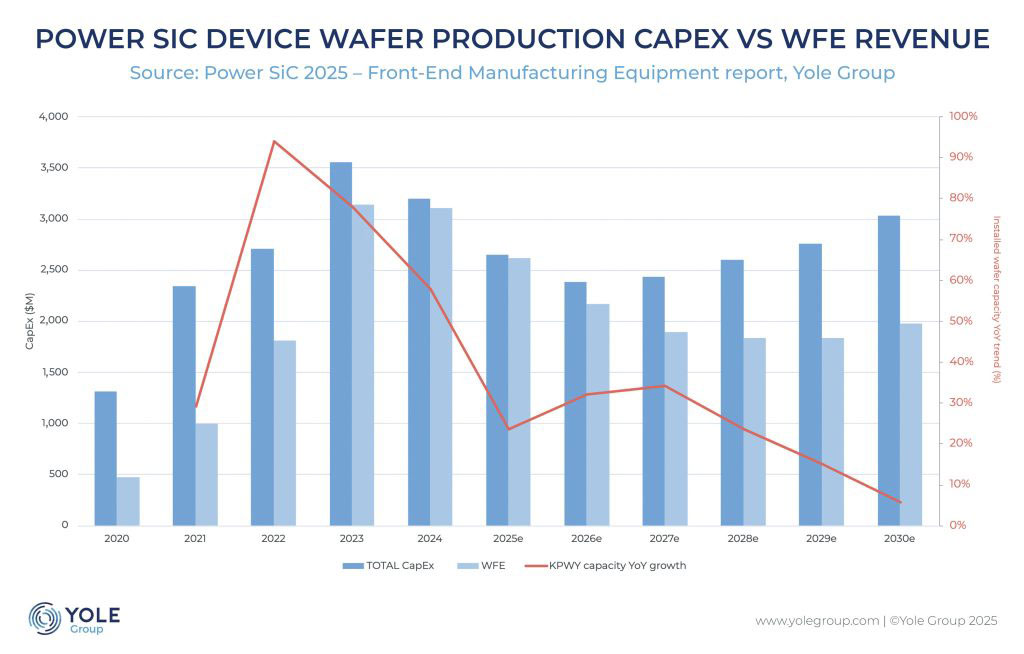
The cycle of falling utilization rates, excess capacity, and reduced investment is raising concerns among industry players. Yet, despite the slowdown, SiC remains central to the electrification roadmap. The downturn is expected to persist until 2027–2028.
“SiC has entered a necessary correction phase. Indeed, after five years of massive investment, the market must absorb capacity before new tools and technologies can drive the next expansion,” says Taguhi Yeghoyan, Yole’s principal technology & market analyst, Semiconductor Equipment.
After 2027–2028, renewed growth will come from 8-inch production platforms and next-generation trench and superjunction MOSFETs, reckons Yole. Device revenue forecast to reach nearly $10bn by 2030.
Regional dynamics: China’s fast rise
Much of the new equipment CapEx is centered in mainland China, where the government’s strategy encourages local procurement of equipment. In 2024, Chinese players already captured about 40% of SiC wafer and epiwafer capacity and are rapidly expanding into device manufacturing. While the equipment ecosystem is not yet fully self-sufficient, domestic suppliers have made significant progress in the physical vapor transport (PVT) and high-temperature chemical vapor deposition (HTCVD) tool segments.
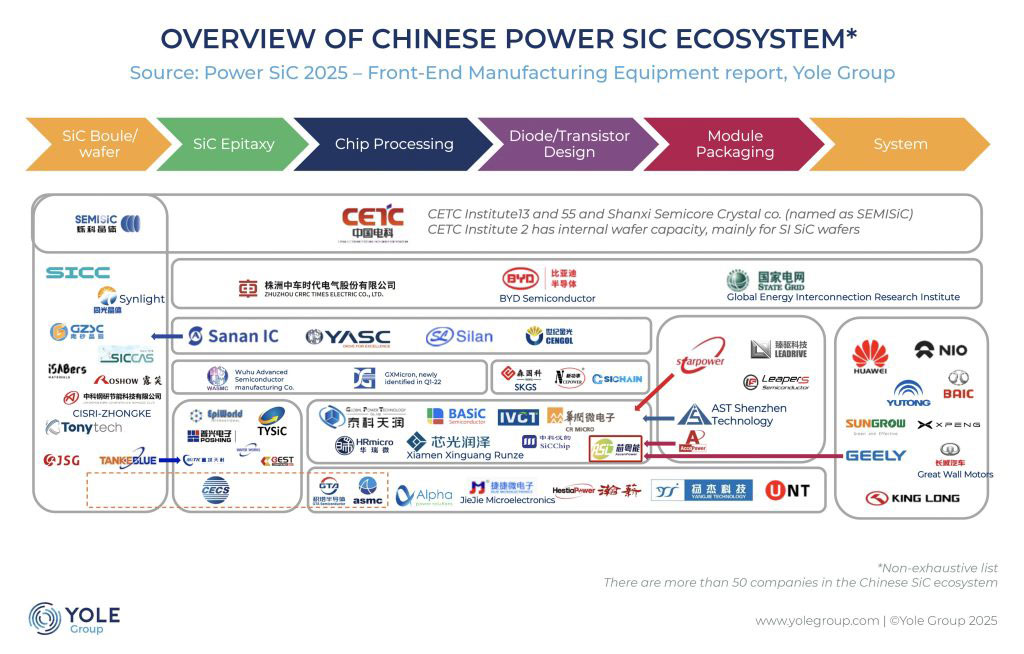
“China is catching up fast on SiC front-end capability,” notes Yeghoyan. “Local vendors now compete head-to-head in SiC crystal growth and epitaxy, even as international players retain leadership in thinning, metrology, and advanced ion implantation.”
Equipment ecosystem outlook
- PVT (boule growth): A mature ecosystem with 8-inch capabilities has been established. The open PVT equipment market, led by Naura, is expected to contract sharply before stabilizing with a compound annual growth rate (CAGR) of about –11% over 2024–2030.
- Epitaxy (HTCVD): European players ASM International and AIXTRON lead, followed by NuFlare and TEL. Chinese vendors Naura, JSG, and NASO Tech are expanding aggressively.
- Wafer fab equipment (WFE) tools: SiC-specific adaptation is required for etch, CMP, ion implantation, and inspection. The market will maintain a CAGR of roughly –7% through 2030, supported by upgrades of the existing installed base.
- Overcapacity in burn-in systems is offsetting the overall growth in test-related equipment, leading to a modest 3% CAGR.
Despite the downturn, IDMs continue strategic investments in 200mm SiC capacity and advanced MOSFET architectures, maintaining global leadership even as China’s domestic ecosystem gains traction.
“After a period of accelerated expansion, the power SiC industry is recalibrating,” notes Poshun Chiu, Yole’s principal technology & market analyst, Compound Semiconductor. “The short-term slowdown masks a long-term transformation toward 200mm production, localized supply chains, and new device architectures that will define the next growth cycle.”
SiC device market growing at 34% CAGR from $1.09bn in 2021 to $6.3bn in 2027