
- News
31 January 2012
Doubling breakdown voltage with double heterostructure
Researchers in China have been using double-heterostructure (DH) nitride semiconductor layers to increase breakdown voltages and reduce off-state leakage of high-electron-mobility transistors (HEMT) [Ma Juncai et al, J. Semicond., 33, p014002, 2012]. Xidian University has been developing the aluminum gallium nitride (AlGaN) barrier devices with a view to higher-voltage and power applications.
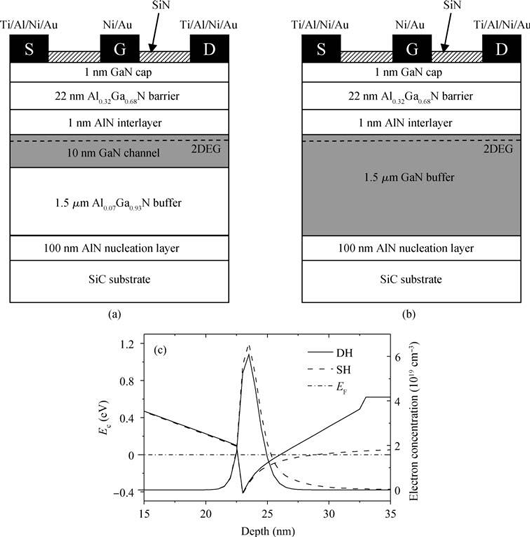
Figure 1: Schematic cross sections of (a) AlGaN/GaN/AlGaN DH and (b) AlGaN/GaN SH and (c) the calculated conduction band diagrams and electron distributions of the DH and SH.
DH-HEMT and conventional single-heterostructure (SH-HEMT) materials (Figure 1) were grown on 4H-polytype silicon carbide (SiC) substrates using low-pressure metal-organic chemical vapor deposition (MOCVD). Simulations using one-dimensional Schrodinger–Poisson coupled equations suggest that the two-dimensional electron gas (2DEG) is more confined in the DH-HEMT case due to the increased barrier height of the AlGaN buffer.
The construction of devices from the epitaxial material consisted of mesa isolation with a plasma etch, deposition and annealing of titanium/aluminum/nickel/gold stacks for the ohmic source–drain contacts, lithography and deposition of nickel/gold for the Schottky gate, and passivation with silicon nitride.
The gate length was 0.5μm and the width 100μm. The gate–drain and gate–source distances were both 1μm.
Hall measurements before transistor processing were made to assess the mobility and carrier concentration of the two material structures. The DH-sample had a 2DEG mobility of 1713cm2/V-s and electron concentration of 8.48x10¹²/cm2. The SH-sample figures were 1605cm2/V-s and 1.07x10¹³/cm2, respectively. These characteristics combine to give a DH sheet resistance of 372Ω/sq. and an SH value of 309Ω/sq.
The researchers comment: “The lower carrier density and higher 2DEG mobility in the DH-HEMT are mainly attributed to the raised conduction band of the AlGaN back-barrier layer, which enables an enhanced 2DEG confinement and thus a deeper and narrower channel, which is consistent with the calculated conduction band diagram and electron distribution.”
Due to the lower conductivity of the channel in the DH-HEMT the maximum drain current and peak transconductance were reduced compared with the SH-HEMT (Table 1). However, the buffer leakage in the off state was reduced by a factor of more than a hundred (i.e. two orders of magnitude). In addition, the off-state breakdown voltage (Figure 2) was approximately doubled.
Characteristic |
SH-HEMT |
DH-HEMT |
Maximum drain current density |
1230mA/mm |
940mA/mm |
Peak transconductance |
240mS/mm |
220mS/mm |
Threshold voltage |
–4.4V |
–3.0V |
Buffer leakage at 10V drain and –6V gate potentials |
7.4x10⁻⁴mA/mm |
1.3x10⁻⁶mA/mm |
Off-state breakdown drain bias at –8V gate potential |
~50V |
~100V |
Table 1: Characteristics of SH-HEMT and DH-HEMT.
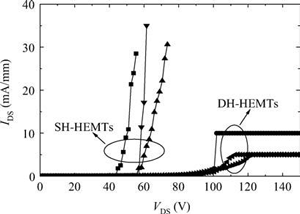 The researchers comment: “The increased back-barrier height of the AlGaN buffer layer suppresses the spillover of the 2DEG into the buffer layer and postpones the punch-through of the buffer layer, thus reducing the subthreshold drain leakage current and increasing the breakdown voltage remarkably.”
Figure 2: Off-state breakdown of conventional AlGaN/GaN SH-HEMTs and AlGaN/GaN/AlGaN DH-HEMTs at a gate voltage of –8V.
Performance at 4GHz was also measured for the DH-HEMT with large signals in a Maury load-pull system. The maximum power-added efficiency (PAE) was 62.3% with a power density of 7.37W/mm at a drain bias of 35V. The maximum output power density achieved was 7.78W/mm. A linear gain of 23dB was also demonstrated.
Further improvements are expected from optimized growth conditions to reduce crystal defects in the AlGaN buffer layer.
DH-HEMT SiC substrates MOCVD AlGaN buffer
The author Mike Cooke is a freelance technology journalist who has worked in the semiconductor and advanced technology sectors since 1997.



 ©2006-2016
Juno Publishing and Media Solutions Ltd. All rights reserved. Semiconductor
Today and the editorial material contained within it and related media is
the copyright of Juno Publishing and Media Solutions Ltd. Reproduction in
whole or part without permission from Juno Publishing and Media Solutions
Ltd is forbidden. In most cases, permission will be granted, if the magazine
and publisher are acknowledged.
©2006-2016
Juno Publishing and Media Solutions Ltd. All rights reserved. Semiconductor
Today and the editorial material contained within it and related media is
the copyright of Juno Publishing and Media Solutions Ltd. Reproduction in
whole or part without permission from Juno Publishing and Media Solutions
Ltd is forbidden. In most cases, permission will be granted, if the magazine
and publisher are acknowledged.